ERP migration has traditionally been one of the most complex technology projects for growing businesses. Moving financial data, customer records, inventory information, supply chain processes, historical transactions, and operational workflows f
rom a legacy ERP system to a modern platform requires careful planning and execution. Even a small error during migration can result in data inconsistencies, business disruption, or unexpected costs.
Artificial intelligence (AI) is changing this process. By combining AI, automation, machine learning, and advanced
nced analytics with modern ERP platforms such as Microsoft Dynamics 365, businesses can make ERP migration faster, safer, and more accurate.
For companies in Texas, working with an experienced Microsoft Dynamics 365 partner in Texas, USA, can provide the expertise needed to combine AI-driven migration capabilities with proven ERP implementation methodologies. From data assessment and cleansing to validation and post-migration optimization, AI can help organizations reduce migration risks while improving the overall transformation experience.
What Is AI-Powered ERP Migration?
AI-powered ERP migration uses artificial intelligence and automation to analyze, classify, clean, transform, validate, and migrate business data between ERP systems.
Traditional migration often depends heavily on manual data mapping and spreadsheet-based processes. Teams may spend weeks reviewing thousands or millions of records to identify duplicate, incomplete, outdated, or incorrectly formatted information.
AI can automate many of these activities. It can identify patterns in existing data, detect anomalies, recommend data mappings, highlight potential errors, and support automated validation before information is transferred to the new ERP environment.
This makes AI particularly valuable when businesses are migrating from older ERP platforms to Microsoft Dynamics 365 Business Central or Dynamics 365 Finance and Operations.
How AI Makes ERP Migration Faster
One of the biggest advantages of AI in ERP migration is speed. Manual migration activities can consume significant time because teams must analyse data, determine relationships between fields, clean records, and perform repeated validation.
AI-powered tools can accelerate these activities by processing large datasets rapidly and identifying patterns that would take human teams considerably longer to discover.
For example, AI can analyse customer records from a legacy system and identify duplicate entries, incomplete addresses, inconsistent naming conventions, or outdated information. Instead of manually reviewing every record, migration teams can focus their attention on exceptions and high-risk data.
Automation can also accelerate repetitive migration tasks such as data extraction, transformation, field mapping, validation, and reporting.
Businesses considering D365 migration services in Texas, USA, can therefore use AI to reduce the amount of manual effort required during migration while maintaining appropriate human oversight.
AI Improves Data Accuracy During Migration
Data accuracy is one of the most important factors in ERP migration. Moving inaccurate information from an old system into a new ERP simply transfers the problem rather than solving it.
AI can help identify inconsistencies before migration begins.
Machine learning algorithms can analyse historical patterns and identify unusual records. For example, AI may flag duplicate customer accounts, unusual inventory quantities, inconsistent supplier information, or financial records that do not follow expected patterns.
AI can also support intelligent data mapping. When field names or structures differ between legacy and new ERP systems, AI can analyse relationships and recommend how data should be mapped.
Human experts can then review these recommendations and approve the appropriate mappings before migration.
This combination of AI automation and human validation can significantly improve data quality.
AI Makes ERP Migration Safer
ERP migration involves sensitive financial and operational information. Businesses must protect data throughout the migration process and ensure that information is transferred correctly.
AI can contribute to migration security by monitoring data processes, identifying unusual activity, detecting anomalies, and supporting automated validation.
AI-driven monitoring can help migration teams identify unexpected changes in data volumes, unusual transaction patterns, or potential inconsistencies during migration testing.
However, AI should not operate independently. A secure ERP migration requires appropriate access controls, encryption, backup strategies, testing procedures, audit trails, and expert oversight.
Experienced Microsoft Dynamics 365 Support Services in Texas, USA, can help businesses maintain a secure and reliable ERP environment before, during, and after migration.
AI-Powered Data Cleansing
Data cleansing is often one of the most time-consuming parts of ERP migration.
Legacy systems may contain years of accumulated information, including duplicate customer records, inactive suppliers, incomplete product information, outdated addresses, inconsistent units of measurement, and incorrectly formatted financial data.
AI can analyse this information and recommend which records should be merged, corrected, archived, or reviewed.
For example, if the same customer appears under several slightly different names, AI can recognize similarities and identify potential duplicates. Migration teams can then validate those recommendations before making changes.
This approach improves data quality while reducing the manual workload involved in preparing data for migration.
AI Supports Intelligent Data Mapping
Every ERP system has its own database structure, terminology, fields, workflows, and business logic. This makes data mapping a critical stage of migration.
AI can compare the structures of legacy and target systems and identify potential relationships between fields.
For example, an AI system may identify that a legacy field containing customer credit information corresponds to a specific customer credit-related field in the target ERP system.
Instead of relying entirely on manual mapping, consultants can use AI-generated recommendations as a starting point and validate them against business requirements.
This can shorten the mapping process and reduce the possibility of human error.
AI Improves Testing and Validation
Testing is essential before an ERP migration goes live. Organizations need to confirm that migrated information is complete, accurate, and usable.
AI can support automated validation by comparing source and target datasets, identifying missing records, checking totals, detecting unusual differences, and highlighting transactions that require additional review.
For financial migration, validation may include comparing account balances, transaction totals, tax information, and historical financial data.
For supply chain operations, AI can help validate inventory quantities, product information, warehouse data, purchase orders, and supplier records.
These capabilities can help organizations identify migration problems earlier rather than discovering them after go-live.
AI and Microsoft Dynamics 365 Business Central
Microsoft Dynamics 365 Business Central is a popular cloud ERP solution for small and medium-sized businesses. Organizations migrating from legacy accounting or ERP platforms can use Business Central to modernize financial management, inventory, purchasing, sales, reporting, and operations.
Companies searching for a microsoft dynamics 365 business central in texas usa solution can benefit from working with an implementation partner that understands both the technology and the business processes involved.
AI can support the migration journey by helping teams analyse legacy data, identify duplicates, improve data quality, automate validation, and accelerate testing.
The result is a more structured transition to Business Central with less dependence on manual processes.
AI and Microsoft Dynamics 365 Finance and Operations
Larger and more complex organizations may require Microsoft Dynamics 365 Finance and Operations for advanced financial management, supply chain management, manufacturing, procurement, asset management, and enterprise operations.
Migration to a sophisticated ERP platform requires careful planning because businesses may have complex data structures, integrations, workflows, customisations, and historical information.
AI can assist with data analysis, mapping, anomaly detection, testing, documentation, and process optimization.
Experienced MS Dynamics 365 implementation services in Texas, USA, can combine these AI capabilities with structured implementation methodologies to create a migration strategy aligned with business objectives.
Why Texas Businesses Need an Experienced Dynamics 365 Partner
Technology alone does not guarantee a successful ERP migration. Businesses need experienced consultants who understand their industry, processes, data, integrations, and long-term objectives.
A trusted microsoft dynamics consulting services in texas usa provider can assess the existing ERP environment, identify migration challenges, recommend the right Dynamics 365 solution, develop a migration roadmap, and support users throughout the transformation.
The right partner can also help determine where AI should be used and where human validation is necessary. This balance is important because AI can accelerate migration activities, but business experts remain essential for making decisions involving financial controls, compliance, operational processes, and business-critical data.
The Future of AI-Powered ERP Migration
AI is moving ERP migration from a largely manual exercise toward a more intelligent and automated process.
Future migration solutions are expected to provide increasingly advanced capabilities for predictive data quality analysis, automated mapping, intelligent testing, process recommendations, anomaly detection, and post-migration optimisation.
Businesses will also be able to use AI to analyze their existing ERP environment before migration and identify inefficient processes that should be redesigned rather than simply transferred to the new system.
This means ERP migration is becoming more than a technology replacement. It is an opportunity to improve how the entire business operates.
Conclusion
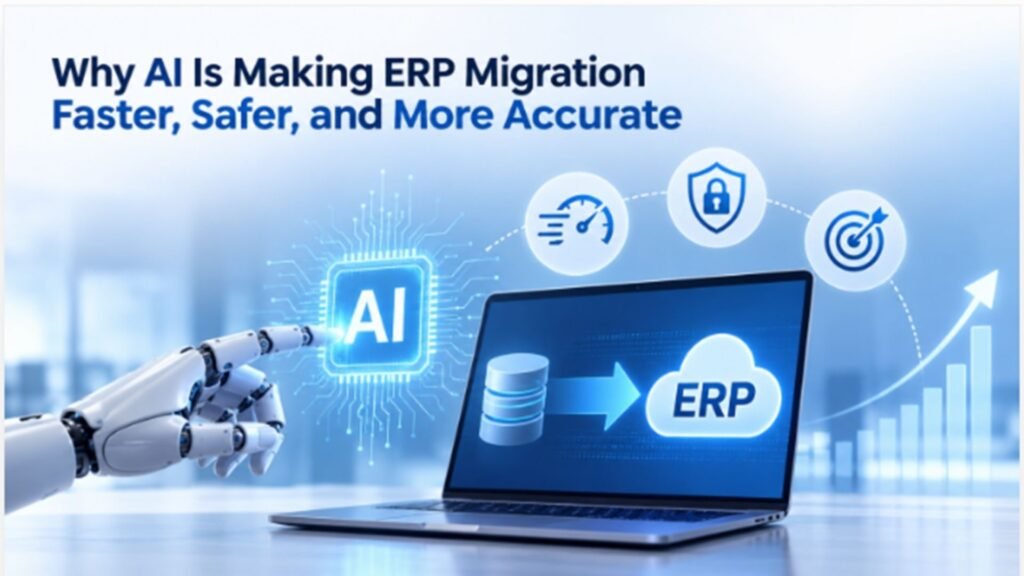
AI is making ERP migration faster, safer, and more accurate by automating repetitive activities, improving data quality, supporting intelligent data mapping, detecting anomalies, and accelerating testing and validation.
For Texas businesses planning a move to Microsoft Dynamics 365, combining AI with professional consulting and implementation expertise can significantly improve the migration journey.
Whether an organisation is moving to Business Central, Dynamics 365 Finance and Operations, or another Microsoft ERP solution, an experienced partner can help create a structured migration strategy while using AI where it delivers the greatest value.
As ERP technology continues to evolve, businesses that combine AI, automation, cloud ERP, and expert consulting will be better positioned to modernise their operations, reduce migration risks, and create a scalable foundation for future growth.
Frequently Asked Questions
Q1. How does AI help with ERP migration?
Ans: AI helps analyze, cleanse, classify, map, validate, and monitor ERP data. It can identify duplicates, anomalies, missing information, and inconsistencies while automating repetitive migration tasks.
Q2. Can AI reduce the time required for ERP migration?
Ans: Yes. AI can automate data analysis, cleansing, mapping, validation, and testing activities, reducing manual effort and helping migration teams complete projects more efficiently.
Q3. Is AI safe for migrating financial and business data?
Ans: AI can support secure migration when implemented within a properly governed ERP migration framework. Businesses should use access controls, encryption, backups, testing, audit trails, and human validation to protect sensitive information.
Q4. Can AI help migrate data to Microsoft Dynamics 365?
Ans: Yes. AI can support data cleansing, transformation, field mapping, anomaly detection, validation, and testing when migrating data to Microsoft Dynamics 365 Business Central or Finance and Operations.
Q5. How can a Microsoft Dynamics 365 partner help with ERP migration?
Ans: A Microsoft Dynamics 365 partner can assess the existing ERP system, develop a migration roadmap, configure the target Dynamics 365 environment, migrate and validate data, manage integrations, train users, and provide post-go-live support.
Q6. What are D365 migration services in Texas?
Ans: D365 migration services in Texas USA include planning, data assessment, data cleansing, migration strategy, system configuration, data migration, testing, integration, deployment, training, and ongoing support for Microsoft Dynamics 365.
Q7. Why choose Microsoft Dynamics 365 Business Central for migration?
Ans: Business Central provides an integrated cloud ERP platform for financial management, sales, purchasing, inventory, operations, reporting, and business processes. It can help growing businesses replace legacy ERP systems with a modern and scalable solution.
Q8. What should businesses look for in a Dynamics 365 implementation partner?
Ans: Businesses should consider Microsoft expertise, ERP implementation experience, industry knowledge, migration capabilities, data expertise, integration skills, customer references, training capabilities, and ongoing support services.
Q9. Can AI detect errors before an ERP migration goes live?
Ans: Yes. AI-powered analysis and automated validation can identify potential duplicates, missing records, unusual values, data inconsistencies, and discrepancies between source and target systems before go-live.
Q10. How can businesses get started with AI-powered ERP migration?
Ans: Businesses should begin with an ERP assessment and migration-readiness review. An experienced Microsoft Dynamics 365 consulting partner can analyse the current environment, identify migration risks, evaluate data quality, and develop a roadmap for moving to the appropriate Dynamics 365 solution.