Inventory management is one of the most critical aspects of running a successful food business. Whether a company operates in food manufacturing, distribution, retail, catering, or restaurant services, maintaining the right inventory levels directly impacts profitability, customer satisfaction, and operational efficiency. Food businesses face unique challenges because many products are perishable, customer demand fluctuates frequently, and supply chain disruptions can occur without warning.
Traditional inventory management methods often rely on historical data, spreadsheets, and manual forecasting. While these approaches may have worked in the past, they are increasingly insufficient in today’s fast-paced and data-driven market. Businesses need smarter ways to predict demand, optimize purchasing decisions, and reduce waste.
This is where artificial intelligence (AI) forecasting is transforming inventory management. AI-powered forecasting tools can analyze vast amounts of data, identify patterns, and generate highly accurate demand predictions. When integrated with modern ERP solutions such as Microsoft Dynamics 365 Business Central, AI forecasting enables food businesses to make informed inventory decisions, reduce costs, and improve overall performance.
Organizations that partner with an experienced Microsoft Dynamics 365 partner can leverage AI capabilities to streamline operations and gain a competitive advantage in the food industry.
Understanding the Inventory Challenges in the Food Industry
Food businesses operate in one of the most complex inventory environments. Unlike other industries, food products often have limited shelf lives, making inventory accuracy extremely important. Overstocking can lead to spoilage and waste, while understocking can result in lost sales and dissatisfied customers.
Some of the most common inventory challenges include:
- Fluctuating customer demand and seasonal purchasing patterns
- Product spoilage, stock shortages, and supply chain disruptions
These challenges make accurate forecasting essential for maintaining profitability and ensuring products are available when customers need them.
For example, a grocery store may experience a sudden increase in demand before a holiday season, while a restaurant may encounter unpredictable customer traffic due to weather conditions or local events. Without accurate forecasting tools, businesses often struggle to balance inventory levels effectively.
What Is AI Forecasting?
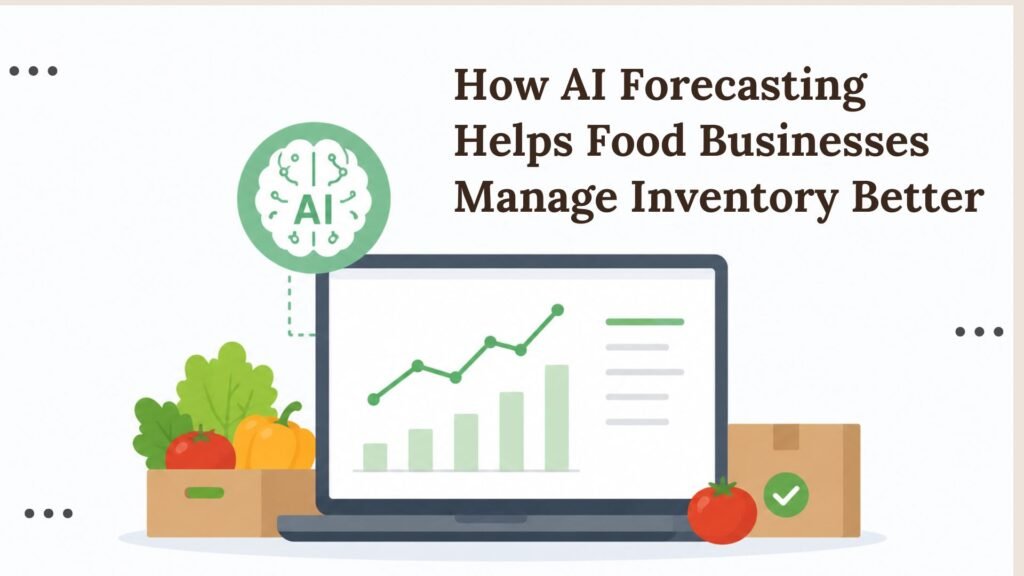
AI forecasting refers to the use of artificial intelligence and machine learning algorithms to predict future demand based on historical and real-time data. Unlike traditional forecasting methods, AI can process large volumes of information from multiple sources simultaneously and identify patterns that may not be visible to human analysts.
AI forecasting systems continuously learn from new data and improve their predictions over time. This makes them significantly more accurate than manual forecasting approaches.
In the food industry, AI forecasting can analyze sales history, customer purchasing behavior, seasonal trends, promotional activities, supplier performance, market conditions, and external factors such as weather forecasts. By evaluating these variables together, AI creates highly reliable demand forecasts that help businesses make better inventory decisions.
The result is improved inventory accuracy, reduced waste, and more efficient operations across the organization.
Why Accurate Inventory Forecasting Matters
Inventory forecasting affects nearly every aspect of a food business. Poor forecasting can lead to excessive inventory costs, product spoilage, and lost revenue opportunities. On the other hand, accurate forecasting supports better planning and improved operational performance.
One of the biggest advantages of accurate forecasting is waste reduction. Food waste remains a major challenge for businesses worldwide. Excess inventory often expires before it can be sold, resulting in financial losses and environmental concerns. AI forecasting helps businesses purchase inventory according to expected demand, significantly reducing spoilage.
Another important benefit is product availability. Customers expect products to be available when they visit a store or place an order. Frequent stock shortages can damage customer trust and encourage shoppers to choose competitors. AI forecasting improves product availability by ensuring that inventory levels align with anticipated demand.
Accurate forecasting also supports stronger financial performance. Businesses can reduce carrying costs, improve cash flow, and maximize profitability by maintaining optimal inventory levels.
How AI Forecasting Works
The AI forecasting process begins with data collection. Modern forecasting systems gather information from multiple sources throughout the organization. This data may include sales transactions, inventory records, supplier information, customer purchasing patterns, seasonal trends, and market conditions.
Once data is collected, machine learning algorithms analyze historical patterns and identify relationships between different variables. For example, the system may recognize that demand for certain products increases during specific holidays or weather conditions.
After analyzing historical and real-time information, the AI model generates demand forecasts for future periods. These forecasts can cover daily, weekly, monthly, or seasonal demand projections.
One of the most valuable aspects of AI forecasting is continuous learning. As new information becomes available, the system automatically updates its models and improves prediction accuracy. This allows businesses to adapt quickly to changing market conditions and customer behaviors.
The Role of Microsoft Dynamics 365 Business Central in Inventory Management
Modern ERP systems play a crucial role in supporting AI-driven forecasting. Microsoft Dynamics 365 Business Central provides a comprehensive platform that connects finance, sales, purchasing, inventory, and operations within a single solution.
By integrating inventory management with forecasting tools, Microsoft Dynamics 365 Business Central enables businesses to gain real-time visibility into stock levels, purchasing requirements, and future demand.
The platform helps businesses monitor inventory across multiple warehouses, automate replenishment processes, and generate intelligent purchasing recommendations. Decision-makers can access detailed reports and dashboards that provide valuable insights into inventory performance.
When implemented correctly, Business Central becomes the foundation for a data-driven inventory management strategy that supports growth and profitability.
Benefits of AI Forecasting for Food Businesses
AI forecasting delivers measurable benefits across every stage of inventory management. Companies that adopt AI-driven forecasting often experience significant improvements in operational efficiency and financial performance.
Key benefits include the following:
- Reduced food waste and inventory carrying costs
- Improved demand accuracy and customer satisfaction
Beyond these advantages, AI forecasting enables businesses to improve procurement planning, optimize warehouse utilization, and strengthen supplier relationships.
More accurate demand predictions allow purchasing teams to negotiate better agreements with suppliers and schedule deliveries more efficiently. This reduces the risk of emergency purchases, which are often more expensive and disruptive.
Additionally, managers can make faster and more confident decisions because they have access to real-time forecasting insights rather than relying on assumptions or outdated reports.
Reducing Food Waste Through AI Forecasting
Food waste represents one of the highest hidden costs in the food industry. Every unsold product that expires before reaching a customer directly impacts profitability.
AI forecasting helps address this challenge by improving inventory planning and purchasing decisions. Instead of ordering products based solely on historical averages, businesses can adjust inventory levels according to expected demand patterns.
For example, if a forecasting system predicts lower demand for a specific product during a certain period, purchasing teams can reduce order quantities accordingly. This prevents excess inventory from accumulating and reduces the likelihood of spoilage.
AI can also identify slow-moving products and highlight items that may be at risk of expiration. Managers can then implement targeted promotions or pricing strategies to move inventory before it becomes waste.
As sustainability becomes increasingly important to consumers and regulators, reducing food waste can also enhance a company’s reputation and support environmental goals.
Improving Supply Chain Efficiency
Inventory management is closely connected to supply chain performance. Delays, shortages, and supplier issues can significantly impact business operations.
AI forecasting improves supply chain efficiency by providing more accurate demand projections. Suppliers receive better visibility into future requirements, allowing them to plan production and deliveries more effectively.
This improved collaboration reduces uncertainty throughout the supply chain and helps businesses avoid disruptions.
Furthermore, AI forecasting can identify potential risks before they become major problems. If demand is expected to increase significantly, procurement teams can secure inventory in advance and avoid shortages during peak periods.
The result is a more resilient and responsive supply chain that supports business growth.
How Microsoft Dynamics Consulting Services Enhance AI Forecasting Projects
Technology alone does not guarantee success. Businesses must also align processes, data, and operational strategies to achieve meaningful results from AI forecasting initiatives.
Professional Microsoft Dynamics consulting services help organizations evaluate their current processes, identify opportunities for improvement, and develop implementation strategies that align with business goals.
Consultants assist with system configuration, workflow optimization, data integration, and user training. Their expertise ensures that forecasting tools are properly implemented and fully utilized.
By working with experienced consultants, organizations can accelerate adoption, minimize implementation risks, and maximize return on investment.
Supporting Digital Transformation Through D365 Migration Services
Many food businesses continue to rely on legacy ERP systems that lack advanced forecasting capabilities. These outdated systems often create data silos and limit visibility across operations.
D365 migration services help organizations transition from legacy platforms to modern cloud-based ERP environments. Migrating to Microsoft Dynamics 365 Business Central provides access to advanced analytics, AI capabilities, and real-time reporting.
A successful migration project establishes a strong foundation for future growth and innovation. Businesses gain access to modern technologies that improve decision-making and support long-term competitiveness.
Cloud-based solutions also offer greater scalability, security, and flexibility, making them ideal for organizations preparing for future expansion.
Importance of MS Dynamics 365 Implementation Services
Implementing a modern ERP system requires careful planning and execution. Professional MS Dynamics 365 implementation services help businesses deploy solutions efficiently while minimizing disruptions to daily operations.
Implementation specialists work closely with stakeholders to configure workflows, integrate data sources, and establish inventory management processes. They ensure that forecasting models are aligned with business objectives and operational requirements.
Proper implementation also improves user adoption and helps employees take full advantage of available features.
By investing in professional implementation services, businesses can accelerate time-to-value and achieve stronger project outcomes.
Why Microsoft Dynamics 365 Support Services Are Essential
Successful inventory management is an ongoing process rather than a one-time project. As business conditions change, forecasting systems must be monitored and optimized to maintain performance.
Microsoft Dynamics 365 Support Services provide ongoing assistance that helps organizations maximize the value of their ERP investment.
Support teams assist with system updates, troubleshooting, performance optimization, and user training. They also help businesses adapt to changing requirements and take advantage of new features as they become available.
Continuous support ensures that forecasting systems remain accurate, reliable, and aligned with organizational goals.
Future Trends in AI Forecasting for Food Businesses
The future of inventory management is increasingly intelligent and automated. Advances in artificial intelligence, machine learning, and predictive analytics continue to expand forecasting capabilities.
Future developments are expected to include deeper integration with IoT devices, real-time supply chain monitoring, autonomous replenishment systems, and more sophisticated predictive models.
Generative AI technologies may also play a role by helping managers interpret forecasting results and make strategic decisions more quickly.
As these innovations become more accessible, businesses that adopt AI forecasting early will be better positioned to compete in a rapidly evolving marketplace.
Conclusion
AI forecasting is revolutionizing the way food businesses manage inventory. By analyzing historical data, customer behavior, market trends, and operational information, AI enables organizations to predict demand with greater accuracy than ever before.
When combined with Microsoft Dynamics 365 Business Central, AI forecasting provides powerful tools for reducing waste, improving product availability, optimizing purchasing decisions, and increasing profitability.
Businesses can further strengthen their success by partnering with a trusted Microsoft Dynamics 365 partner, leveraging expert Microsoft Dynamics consulting services, utilizing D365 migration services, implementing solutions through professional MS Dynamics 365 implementation services, and maintaining performance with reliable Microsoft Dynamics 365 support services.
As the food industry continues to evolve, organizations that embrace AI-driven forecasting will be better equipped to manage inventory efficiently, meet customer expectations, and achieve sustainable growth.
Frequently Asked Questions
Q1. What is AI forecasting in inventory management?
Ans: AI forecasting uses machine learning and data analytics to predict future demand and help businesses optimize inventory levels.
Q2. How does Microsoft Dynamics 365 Business Central support inventory management?
Ans: Microsoft Dynamics 365 Business Central provides real-time inventory visibility, forecasting tools, purchasing automation, and reporting capabilities.
Q3. Why is AI forecasting important for food businesses?
Ans: It improves demand accuracy, reduces waste, minimizes stock shortages, and increases operational efficiency.
Q4. How can a Microsoft Dynamics 365 partner help?
Ans: A Microsoft Dynamics 365 partner assists with implementation, customization, integration, training, and ongoing support.
Q5. What are D365 migration services?
Ans: D365 migration services help businesses move from legacy systems to modern Dynamics 365 solutions.
Q6. Why are Microsoft Dynamics consulting services valuable?
Ans: Consultants help organizations optimize processes, configure systems, and maximize the benefits of AI forecasting.
Q7. What do MS Dynamics 365 implementation services include?
Ans: Implementation services include planning, configuration, data migration, testing, training, and deployment.
Q8. Why are Microsoft Dynamics 365 Support Services important?
Ans: They ensure system reliability, provide troubleshooting assistance, and help businesses continuously optimize performance.
Q9. Can small food businesses benefit from AI forecasting?
Ans: Yes. Businesses of all sizes can improve inventory accuracy, reduce waste, and enhance profitability through AI forecasting.
Q10. What is the future of AI forecasting?
Ans: Future trends include predictive analytics, autonomous replenishment, IoT integration, and real-time supply chain intelligence.