Quick Answer
A Microsoft Dynamics 365 F&O implementation partner in the USA is a certified firm that plans, configures, customizes, integrates, deploys, and supports Dynamics 365 Finance and Operations for U.S. businesses. The right partner combines Microsoft certifications, industry experience, U.S. compliance knowledge, a proven methodology, and strong post-go-live support.
What Is Dynamics 365 Finance and Operations (F&O)?
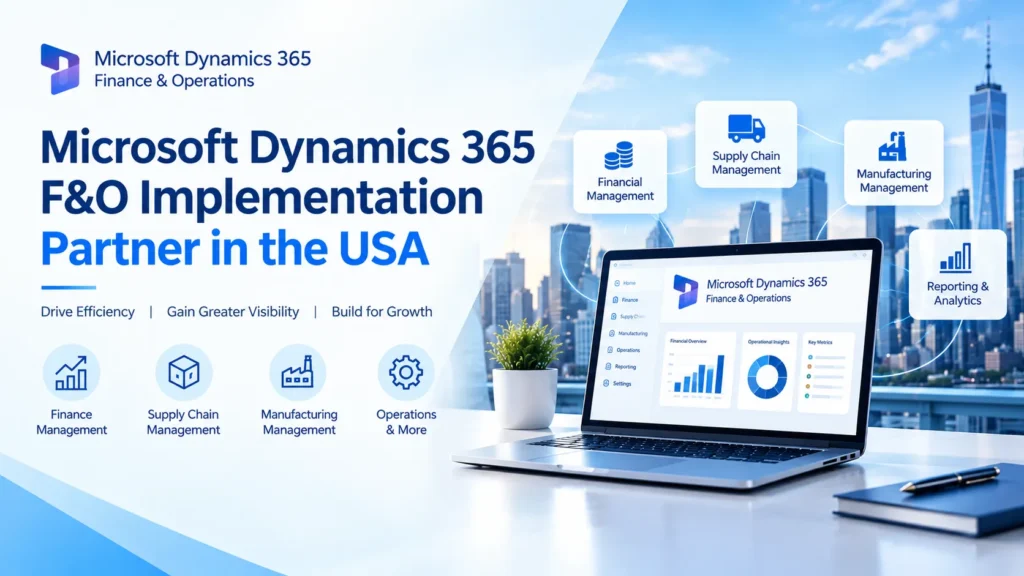
Microsoft Dynamics 365 Finance and Operations is a cloud-based ERP platform for mid-size and large organizations. It brings core business processes into one system:
- Finance: general ledger, accounts payable and receivable, budgeting, fixed assets
- Supply chain management: procurement, inventory, warehouse, transportation
- Manufacturing: production planning, shop floor control, quality management
- Project operations: project accounting, resource planning, billing
- Analytics and AI: Power BI, Copilot, and built-in forecasting
Many U.S. companies are retiring legacy ERPs such as Dynamics AX, GP, or NAV, or outgrowing QuickBooks and similar tools. They choose F&O for scalability, multi-entity and multi-currency support, and tight integration with Microsoft 365 and Power Platform.
Because F&O is powerful and highly configurable, the quality of the implementation matters as much as the software.
Why You Need a D365 F&O Implementation Partner in the USA
You can buy licenses from Microsoft, but turning them into a working system takes specialized expertise. A strong D365 F&O implementation partner in the USA helps you:
- Reduce risk. Experienced teams know where projects stall, such as data migration, integrations, and change management.
- Meet U.S. requirements. Sales tax, 1099 reporting, GAAP, SOX controls, and state-level rules need local knowledge.
- Shorten time to value. Proven templates and accelerators speed up deployment.
- Align with your industry. Manufacturing, distribution, retail, and professional services each need different configurations.
- Support you after go-live. Dynamics 365 receives continuous updates, so ongoing support is essential.
What Does an F&O Implementation Partner Actually Do?
A good partner covers the full lifecycle, not just the technical setup.
| Phase | What the Partner Does | Your Outcome |
|---|---|---|
| Discovery & Planning | Workshops, requirement gathering, fit-gap analysis, roadmap | Clear scope, budget, and timeline |
| Solution Design | Architecture, process design, integration planning | Blueprint aligned to business goals |
| Configuration & Customization | Setup, extensions, reports, workflows | System tailored to your processes |
| Data Migration | Cleansing, mapping, validation, trial loads | Accurate, reliable data in F&O |
| Integration | Connecting CRM, e-commerce, EDI, banks, third-party apps | Seamless data flow across systems |
| Testing | Unit, system, performance, and user acceptance testing | Confidence before go-live |
| Training & Change Management | Role-based training, documentation, adoption support | Users who trust and use the system |
| Go-Live & Support | Cutover, hypercare, managed services | Stable operations and continuous improvement |
Key Qualities to Look for in a Dynamics 365 F&O Partner in the USA
Not every D365 F&O partner in the USA is the same. Use these criteria to compare your shortlist.
Microsoft Credentials and Certifications: Look for a current Microsoft Solutions Partner designation for business applications and consultants holding Dynamics 365 Finance and Supply Chain certifications. Ask to see current credentials, not just logos on a website.
Proven F&O Experience: Ask how many F&O projects the firm has completed and whether they match your size and complexity. A partner experienced mainly with Business Central or small deployments may not be ready for a multi-entity F&O rollout.
Industry Expertise
Industry knowledge cuts discovery time and reduces custom development.
| Industry | Common F&O Needs |
|---|---|
| Manufacturing | Production planning, BOMs, quality control, shop floor |
| Distribution & Wholesale | Warehouse management, demand planning, EDI |
| Retail | Omnichannel, inventory visibility, point of sale |
| Professional Services | Project accounting, resource management, billing |
| Healthcare & Life Sciences | Compliance, traceability, lot tracking |
| Nonprofit & Public Sector | Fund accounting, grants, budgeting |
Transparent Methodology: A mature partner follows a structured approach, often based on Microsoft’s Success by Design framework, with defined milestones, governance, and communication. Be cautious of vague plans or a firm that cannot explain how it manages scope changes.
U.S. Presence and Support Model: Time zone alignment, local compliance knowledge, and responsive support matter. Confirm whether the team is U.S.-based, hybrid, or offshore, and how support hours are covered.
Customer References: Request references and case studies from similar companies. Ask them about budget accuracy, timeline adherence, and post-go-live support quality.
Post-Implementation Services: Microsoft releases updates regularly. Your partner should offer managed services, upgrade support, user training, and optimization, so the system keeps pace with your business.
Questions to Ask Before You Hire
Use this list during partner interviews:
- How many D365 F&O implementations have you completed in the last three years?
- Do you have experience in my industry and with companies of my size?
- Who will be on my project team, and what are their certifications?
- How do you handle data migration and testing?
- What is your approach to customizations versus standard functionality?
- How do you manage scope changes and budget overruns?
- What does your post-go-live support look like?
- Can I speak with three recent customers?
Typical D365 F&O Implementation Timeline
Timelines depend on scope, number of legal entities, integrations, and data volume. These are general ranges, not guarantees. Always validate with your partner.
| Project Size | Typical Duration | Characteristics |
|---|---|---|
| Small to mid-size | 4–8 months | Single or few entities, limited customization |
| Mid-size to large | 8–14 months | Multiple entities, several integrations, some custom development |
| Enterprise | 12–24 months | Global rollouts, complex manufacturing or supply chain, heavy integration |
What Influences Implementation Cost?
Pricing varies widely, so ask for a detailed estimate rather than relying on averages. The main cost drivers are:
- Licensing: number and type of users and modules selected
- Implementation services: consulting, configuration, project management
- Customization: extensions, reports, and custom workflows
- Integrations: third-party systems, EDI, banks, and e-commerce
- Data migration: volume and quality of legacy data
- Training and change management: number of users and locations
- Ongoing support: managed services and upgrades
Tip: Reducing unnecessary customization is one of the most effective ways to control cost and simplify future updates.
Common Implementation Mistakes to Avoid
| Mistake | Why It Hurts | How to Avoid It |
|---|---|---|
| Choosing a partner on price alone | Low bids often hide scope gaps and change orders. | Compare scope, experience, and references. |
| Over-customizing | Raises cost and complicates upgrades | Use standard features wherever possible. |
| Poor data quality | Causes errors and delays at go-live | Start cleansing early; run multiple trial migrations. |
| Weak executive sponsorship | Slows decisions and adoption | Assign an engaged internal project owner. |
| Skipping training | Users revert to old habits. | Invest in role-based training and change management. |
| No post-go-live plan | Issues pile up after launch. | Plan hypercare and managed support upfront. |
Benefits of Working with the Right F&O Partner
When you choose well, the results go beyond a successful go-live:
- Faster financial close and better real-time visibility
- Streamlined supply chain with improved inventory accuracy
- Stronger compliance and audit readiness
- Better decisions through integrated analytics and Power BI
- Scalability to support growth, acquisitions, and new markets
- Lower long-term cost through a clean, upgrade-friendly system
How to Shortlist a Microsoft Dynamics 365 F&O Implementation Partner in the USA: A Simple 5-Step Process
- Define your goals. List business objectives, key processes, and must-have integrations.
- Research partners. Use Microsoft’s partner directory, peer recommendations, and industry reviews.
- Issue an RFP or discovery request. Ask for approach, team, timeline, and pricing structure.
- Evaluate and compare. Score each partner on experience, methodology, support, and cultural fit.
- Check references and decide. Speak with past clients and confirm contract terms and responsibilities.
Frequently Asked Questions (FAQs)
Q1. What is a Microsoft Dynamics 365 F&O implementation partner in the USA?
Ans: It is a Microsoft-certified firm based in or serving the United States that helps businesses plan, configure, deploy, and support Dynamics 365 Finance and Operations, including data migration, integration, training, and ongoing support.
Q2. How long does a D365 F&O implementation take?
Ans: Most projects take between 4 and 24 months, depending on company size, number of legal entities, customization, and integrations. Your partner should give a phased timeline after discovery.
Q3. How much does it cost to hire a D365 F&O implementation partner in USA?
Ans: Cost depends on scope, users, modules, customization, and data complexity. Request a detailed proposal from several partners, and compare what each includes rather than only the total price.
Q4. How do I know if a D365 F&O partner is qualified?
Ans: Check their Microsoft Solutions Partner status, consultant certifications, industry experience, customer references, and a clear implementation methodology.
Q5. Should I choose a local U.S. partner or an offshore one?
Ans: Many successful projects use a hybrid model. What matters is U.S. compliance knowledge, time zone coverage, clear communication, and accountability. Ask where your project team will be located.
Q6. Can a partner migrate data from my legacy ERP into F&O?
Ans: Yes. Experienced partners handle data cleansing, mapping, trial migrations, and validation from systems such as Dynamics AX, GP, NAV, SAP, Oracle, or QuickBooks.
Q7. What support is available after go-live?
Ans: Most partners offer hypercare right after launch and then managed services, covering issue resolution, updates, user training, and enhancements.
Q8. Is Dynamics 365 F&O right for my business?
Ans: F&O suits mid-size to large organizations with complex finance, supply chain, or manufacturing needs. Smaller businesses may be better served by Dynamics 365 Business Central. A good partner will advise honestly.
Summary
Choosing a Microsoft Dynamics 365 F&O implementation partner in USA is one of the most important decisions in your ERP journey. The software is powerful, but results depend on the people who implement it.
Key takeaways:
- A strong F&O implementation partner in USA manages the entire lifecycle, from discovery to post-go-live support.
- Evaluate D365 F&O partners in USA on certifications, industry experience, methodology, U.S. compliance knowledge, and references.
- Control cost and risk by limiting customization, cleansing data early, and investing in training.
- Plan for support after go-live, because Dynamics 365 evolves continuously.
- Compare at least three partners, and look beyond price to long-term value.
If you are ready to modernize your finance and operations, start by defining your goals, shortlisting qualified partners, and asking the right questions. The right D365 F&O partner in USA will act as a long-term advisor, not just a vendor.