Hire Dynamics 365 Consultants

Why-Flexible-ERP-Teams-Are-the-Future-of-Digital-transformation

Why Flexible ERP Teams Are the Future of Digital Transformation

In today’s rapidly changing business environment, organizations are under constant pressure to innovate, adapt, and scale faster than ever before. Digital transformation is no longer a long-term vision — it has become a business necessity. Companies across industries are investing in cloud technologies, automation, artificial intelligence, and enterprise solutions to stay competitive. At the center of this transformation lie ERP systems, especially platforms like Microsoft Dynamics 365 and Microsoft Dynamics 365 Business Central. However, technology alone does not guarantee success. Businesses also need skilled, agile, and flexible ERP teams that can adapt quickly to changing business needs. Traditional fixed IT teams often struggle to keep pace with modern digital demands. This is why flexible ERP teams are becoming the future of digital transformation. Organizations are now increasingly relying on scalable ERP experts, remote consultants, implementation specialists, and managed support teams to accelerate transformation projects while reducing operational costs. Whether it is cloud migration, ERP upgrades, or process automation, flexible ERP teams provide businesses with the expertise and scalability they need. The Shift Toward Flexible ERP Teams For years, companies depended heavily on in-house IT departments to manage ERP systems. While this model worked in the past, modern digital transformation projects require specialized expertise across multiple domains such as cloud computing, integrations, cybersecurity, analytics, and automation. Hiring permanent employees for every ERP function can be expensive and time-consuming. Moreover, digital transformation projects often require temporary specialized skills that may not be needed long-term. This is where flexible ERP teams create value. Flexible ERP teams allow businesses to: Businesses working with a trusted Microsoft ecosystem partner or a reliable Microsoft Dynamics 365 partner can quickly access experienced consultants, developers, support specialists, and project managers without long recruitment cycles. Why Digital Transformation Requires Agility Digital transformation projects are dynamic by nature. Requirements change frequently due to evolving market trends, customer expectations, and technology advancements. Companies need ERP teams that can respond quickly to these changes. Traditional ERP models are often rigid and slow. Flexible ERP teams, on the other hand, offer agility and responsiveness. They can adapt to new business priorities, integrate emerging technologies, and optimize processes continuously. For example, a manufacturing company implementing Microsoft Dynamics 365 Business Central may initially focus on finance and inventory management. Later, they may decide to add AI-driven forecasting, warehouse automation, or CRM integrations. Flexible ERP teams can seamlessly expand the project scope without major disruptions. This adaptability is one of the key reasons why businesses increasingly invest in Microsoft Dynamics consulting services and cloud ERP specialists. The Growing Importance of Microsoft Dynamics 365 Modern organizations require ERP systems that support scalability, remote work, automation, and data-driven decision-making. Microsoft Dynamics 365 has emerged as one of the leading ERP and CRM platforms because it combines flexibility, intelligence, and cloud capabilities. Businesses implementing Microsoft Dynamics 365 Business Central can centralize operations, improve productivity, and gain real-time business visibility. However, successful ERP implementation depends heavily on having the right team. A skilled Microsoft Dynamics 365 partner helps organizations: Flexible ERP teams make these services more accessible and cost-effective for businesses of all sizes. Benefits of Flexible ERP Teams 1. Faster ERP Implementations One of the biggest challenges businesses face during ERP implementation is project delays. Traditional hiring processes slow down project execution because finding skilled ERP professionals takes time. Flexible ERP teams provide immediate access to experienced consultants and developers, accelerating deployment timelines. Businesses can start projects quickly and reduce downtime. Organizations using MS Dynamics 365 implementation services often benefit from faster onboarding, streamlined workflows, and reduced implementation risks when working with scalable ERP teams. 2. Access to Specialized Expertise Digital transformation projects require expertise in multiple areas, including: Instead of maintaining a large in-house team, businesses can access specialists only when needed. Flexible ERP teams allow organizations to bring in experts for specific phases of the project. For example, companies using D365 migration services may require temporary migration specialists during system upgrades but not afterward. Flexible staffing models eliminate unnecessary long-term costs. 3. Reduced Operational Costs Hiring full-time ERP professionals can be expensive, especially for small and mid-sized businesses. Flexible ERP teams reduce overhead costs related to: Businesses only pay for the expertise they need, making digital transformation more affordable and scalable. Many companies now prefer outsourcing Microsoft Dynamics 365 support rather than maintaining large in-house support departments. 4. Improved Business Continuity ERP systems are critical for daily business operations. Downtime or technical issues can lead to revenue loss and productivity disruptions. Flexible ERP teams provide continuous support and proactive monitoring to ensure system stability. Businesses can access remote ERP experts across different time zones, enabling faster issue resolution and improved operational continuity. A reliable Microsoft Dynamics 365 partner ensures that ERP systems remain secure, optimized, and fully functional even during business expansion or system upgrades. 5. Easier Cloud Migration Cloud ERP adoption continues to grow because it offers scalability, flexibility, and remote accessibility. However, cloud migration can be complex without the right expertise. Flexible ERP teams simplify migration processes by providing skilled consultants experienced in: Organizations investing in D365 migration services can minimize migration risks and ensure smooth transitions to cloud-based ERP environments. Flexible ERP Teams and Remote Work Culture The rise of hybrid and remote work models has further increased the demand for flexible ERP teams. Modern businesses need ERP professionals who can collaborate virtually and support distributed teams. Cloud-based platforms like Microsoft Dynamics 365 allow ERP consultants, developers, and support teams to work remotely while maintaining productivity and collaboration. Remote ERP teams offer several advantages: This flexibility enables businesses to remain agile and competitive in an increasingly digital economy. The Role of Automation in Flexible ERP Teams Automation is transforming how ERP systems operate. Businesses are increasingly using AI-powered workflows, robotic process automation, and predictive analytics to improve efficiency. Flexible ERP teams help organizations implement automation strategies more effectively. Experienced consultants can identify repetitive processes and integrate intelligent automation solutions into ERP systems. Some common automation areas include: Organizations leveraging Microsoft Dynamics consulting services

Why Flexible ERP Teams Are the Future of Digital Transformation Read More »

license-based-erp

Subscription vs. License-Based ERP: Which Is Better for Long-Term Growth?

In today’s fast-evolving digital economy, Enterprise Resource Planning (ERP) systems are the backbone of business operations — integrating finance, supply chain, manufacturing, sales, and human resources into one unified platform. But when it comes to adopting an ERP, one question keeps business leaders and IT managers debating: Should you choose a subscription-based (cloud) ERP or a license-based (on-premises) ERP? This question isn’t just about pricing models; it’s about long-term scalability, innovation, and total cost of ownership (TCO). As more businesses move toward cloud-based solutions like Microsoft Dynamics 365, it’s important to understand what each model offers — and which one aligns best with your growth strategy. In this article, we’ll explore the key differences between subscription and license-based ERP models, their advantages and drawbacks, the financial and operational impacts, and how to choose the right option for long-term success. Understanding ERP Deployment and Licensing Models Before diving into comparisons, let’s clarify what these two models mean in practice. 1. License-Based ERP (Perpetual License) A license-based ERP involves purchasing a software license outright, which gives your company the right to use the software indefinitely. Traditionally, this model is paired with on-premises deployment, where the software is installed on your own servers, and your internal IT team (or a partner) manages the infrastructure, upgrades, and security. Key Characteristics: Examples: Microsoft Dynamics AX, SAP ECC, Oracle E-Business Suite (legacy editions) 2. Subscription-Based ERP A subscription-based ERP operates under a pay-as-you-go model. You pay a recurring monthly or annual fee to access the software, which is typically hosted in the cloud by the vendor or a managed partner. Key Characteristics: Examples: Microsoft Dynamics 365 Business Central, Oracle NetSuite, SAP S/4HANA Cloud Key Differences Between Subscription and License-Based ERP Factor Subscription-Based ERP (SaaS) License-Based ERP (Perpetual) Cost Structure Monthly/annual OPEX One-time CAPEX + maintenance Deployment Cloud-hosted On-premises or private cloud Scalability Easily scalable up or down Limited by hardware and licenses Upgrades Automatic, frequent updates Manual upgrades; costly & disruptive Security & Compliance Managed by vendor (enterprise-grade) Managed internally Customization Limited but configurable Deep customization possible Integration with Modern Tools Native integration with cloud apps, AI, Power BI May require manual integrations Access & Mobility Accessible anywhere, anytime Typically on-premises access TCO (Total Cost of Ownership) Lower over time for SMBs and mid-market Potentially lower for large enterprises over 10+ years Deep Dive: Advantages and Drawbacks of Each Model Subscription-Based ERP – The Modern Approach Advantages: Drawbacks: License-Based ERP – The Traditional Powerhouse Advantages: Drawbacks: Total Cost of Ownership (TCO) Comparison When evaluating ERP options, cost must be viewed beyond licensing alone. Here’s how both models typically compare across time: Cost Element Subscription ERP (Cloud) License ERP (On-Premises) License Monthly/annual subscription One-time perpetual license Infrastructure Included in subscription Requires servers, network, backup Maintenance Included Annual support fee (15–25%) Upgrades Included automatically Paid upgrades (every 5–7 years) IT Staff Minimal Dedicated internal team required Security Managed by vendor Managed in-house Scalability On-demand Hardware-dependent Long-Term Cost (10 yrs) Potentially higher for very large users Potentially lower after break-even point Insight:For small and mid-sized businesses (SMBs), subscription ERP typically offers lower TCO and higher agility. For large enterprises with established IT infrastructure and predictable operations, license-based ERP may eventually become more cost-efficient — provided they manage it effectively. The Future is Cloud – Here’s Why Over the past decade, the ERP landscape has undergone a massive transformation. According to industry reports, more than 80% of new ERP implementations today are cloud-based. Microsoft, SAP, and Oracle are all transitioning customers from their legacy on-premises products to modern SaaS platforms. Here’s why cloud subscription models are dominating: Which Model Is Right for You? The decision depends on your size, industry, IT maturity, budget, and growth objectives. Here’s a practical framework: Choose Subscription-Based ERP (Cloud) Choose License-Based ERP (On-Premises) : Hybrid ERP: The Best of Both Worlds Many companies are now adopting hybrid ERP models, combining the stability of on-premises systems with the flexibility of cloud applications. For instance, a manufacturer may run core financials and operations in Dynamics 365 Finance (cloud) while maintaining on-premises systems for shop-floor control or legacy integrations. The hybrid model provides a balanced approach to innovation and control. Benefits of Hybrid ERP: Drawbacks: Nevertheless, hybrid ERP serves as a strategic bridge for organizations transitioning from legacy systems toward full digital transformation. Microsoft Dynamics 365: A Real-World Example Microsoft Dynamics 365 offers flexible licensing options — subscription-based SaaS as the default model and on-premises deployment for specific industries and compliance needs. Why it stands out: For businesses aiming for long-term growth, Dynamics 365’s cloud-first model enables agility, innovation, and scalability while maintaining enterprise-grade security and compliance. The Strategic View: Long-Term Growth Implications When evaluating ERP models for long-term growth, think beyond immediate costs — focus on strategic flexibility, innovation velocity, and business resilience. Growth Factor Subscription (Cloud) License (On-Prem) Innovation Continuous delivery, AI-first Limited upgrades Scalability Dynamic scaling Hardware-dependent Agility Rapid deployment & updates Slow change cycles Cost Control Predictable, flexible High upfront, low variable Security Vendor-managed enterprise-grade Internal responsibility Long-Term ROI High for fast-growing firms High for stable enterprises Future Readiness Built for digital transformation May require modernization later In essence, subscription-based ERP is the better choice for most growing organizations. It offers agility, lower barriers to entry, and constant innovation — all essential in an economy defined by rapid technological change. License-based ERP still has relevance for specific industries and large enterprises needing full control, but even these organizations are gradually adopting hybrid or cloud-first strategies. Conclusion Both subscription-based and license-based ERP models have their place in today’s business landscape. However, when it comes to long-term growth, the balance increasingly tilts toward the subscription (cloud) model. Subscription ERP: License ERP: For most businesses aiming to future-proof their operations, cloud ERP platforms like Microsoft Dynamics 365 represent the smarter, more sustainable path forward. As the world continues to shift toward AI-driven, data-centric operations, flexibility and continuous innovation will define success — and subscription-based ERP models are designed precisely for that. Frequently Asked Questions (FAQs) Q

Subscription vs. License-Based ERP: Which Is Better for Long-Term Growth? Read More »

Managed-Services-Reduce-ERP-TCO

How Our Managed Services Reduce ERP TCO for USA & Canadian Companies

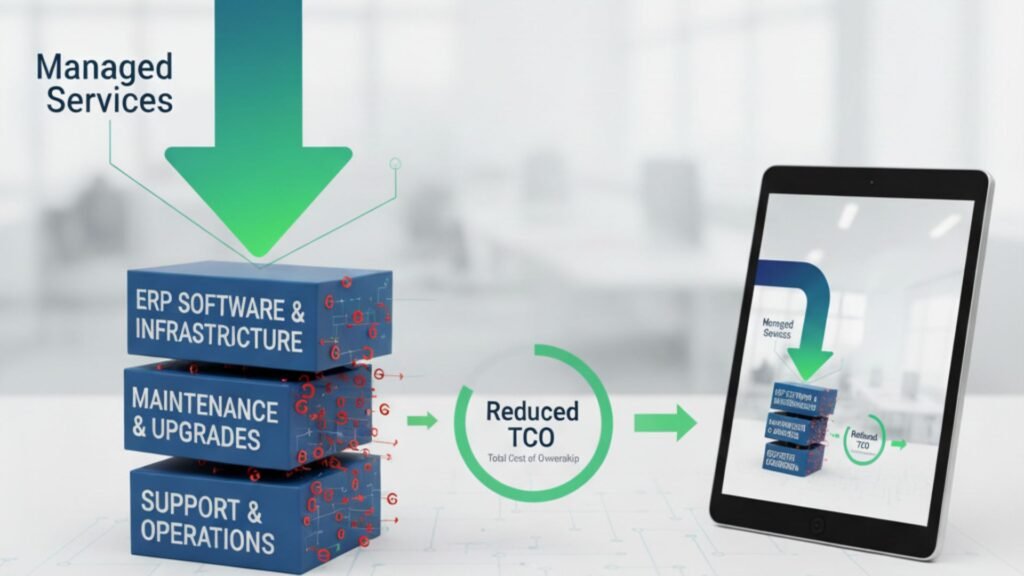
In today’s competitive market, businesses in the USA and Canada are constantly looking for ways to optimize operations, reduce costs, and improve performance. Enterprise Resource Planning (ERP) systems like Microsoft Dynamics 365 play a pivotal role in achieving these goals. However, one of the most overlooked factors in ERP success is the total cost of ownership (TCO). The initial investment in ERP software is just the beginning. Ongoing support, upgrades, integration, staff training, and downtime costs can significantly increase TCO if not managed properly. That’s where managed services come into play. By partnering with a trusted Microsoft Dynamics 365 partner in USA and Canada, companies can unlock predictable costs, improved efficiency, and long-term ROI. In this article, we’ll explore how our managed services help businesses reduce ERP TCO while ensuring reliability, scalability, and compliance. Understanding ERP TCO Before we dive into cost reduction strategies, let’s clarify what ERP TCO (Total Cost of Ownership) includes. It covers: Without structured support, these expenses can spiral out of control. Managed services provide a proactive approach to keep ERP costs predictable and aligned with business outcomes. How Managed Services Reduce ERP TCO 1. Proactive Monitoring & Issue Resolution Unplanned downtime is one of the biggest hidden ERP costs. A single hour of downtime in industries like manufacturing, retail, or hospitality can cost thousands of dollars. With our Microsoft Dynamics 365 Support Services in USA and Canada, we proactively monitor your ERP environment 24/7. This reduces operational disruptions, leading to lower indirect ERP costs. 2. Predictable Cost Structure Traditional ERP support is reactive, often involving costly emergency fixes. Our managed services replace this uncertainty with predictable, subscription-based pricing models. Instead of unpredictable bills for system outages or upgrade delays, businesses benefit from: For companies seeking ERP Implementation Services in USA and Canada, predictable costs make budgeting easier and more reliable. 3. Optimized ERP Performance ERP systems require regular optimization to align with changing business needs. Our managed services ensure Dynamics 365 runs at peak efficiency by: An optimized ERP reduces processing times, improves employee productivity, and lowers operational costs over time. 4. Scalable Support for Growing Businesses As businesses expand across the USA and Canada, their ERP requirements evolve. Without proper planning, scaling can lead to expensive re-implementations. By partnering with a trusted Microsoft Dynamics 365 partner in USA and Canada, companies benefit from: Scalable ERP support avoids costly system overhauls and keeps TCO under control. 5. Improved Security & Compliance Cybersecurity breaches and compliance penalties can drastically increase ERP costs. Our Microsoft Dynamics 365 Support Services in USA and Canada include: Stronger security reduces risk exposure and eliminates unexpected compliance costs. 6. Faster Upgrades & Migration ERP upgrades and migrations are often time-consuming and expensive if mishandled. We specialize in ERP Migration Services in USA and Canada, ensuring a smooth transition from legacy systems to Microsoft Dynamics 365. Key benefits include: Our approach significantly reduces the time and cost associated with upgrades and migrations. 7. Enhanced User Training & Adoption Poor adoption is another hidden driver of high ERP TCO. Many organizations underestimate the cost of retraining employees or handling productivity losses due to lack of knowledge. As part of our managed services, we provide: This maximizes ERP utilization and ensures companies get the full return on their Dynamics 365 investment. Why Choose Us as Your Microsoft Dynamics 365 Partner in USA and Canada Choosing the right partner is critical for reducing ERP TCO. We go beyond traditional support by delivering: With us as your Microsoft Dynamics 365 partner in USA and Canada, you don’t just get technical support—you get a strategic partner committed to driving long-term value. Business Impact: How Managed Services Lower ERP TCO Let’s break down the tangible benefits: Cost Driver Without Managed Services With Managed Services Downtime High, unpredictable Minimal due to proactive monitoring Support Costs Unplanned, reactive Predictable monthly/annual plans Upgrades & Migrations Expensive, high-risk Streamlined, automated, faster Security & Compliance Reactive, risk-prone Continuous audits, reduced fines User Adoption Poor, retraining needed Strong training support Scalability Costly re-implementations Flexible, cloud-ready growth The result? A significantly lower ERP TCO and a higher ROI on your Dynamics 365 investment. Conclusion ERP systems like Microsoft Dynamics 365 are essential for modern enterprises, but without proper management, the total cost of ownership can escalate quickly. Our managed services offer a structured, proactive, and scalable approach that keeps ERP costs predictable and controlled. Whether you are considering ERP Implementation Services in USA and Canada, planning a migration, or seeking ongoing Microsoft Dynamics 365 Support Services in USA and Canada, partnering with us ensures you achieve maximum value at the lowest possible TCO. If you’re ready to transform ERP from a cost center into a growth enabler, it’s time to work with a Microsoft Dynamics 365 partner in USA and Canada who understands your challenges and delivers solutions tailored to your business.

How Our Managed Services Reduce ERP TCO for USA & Canadian Companies Read More »