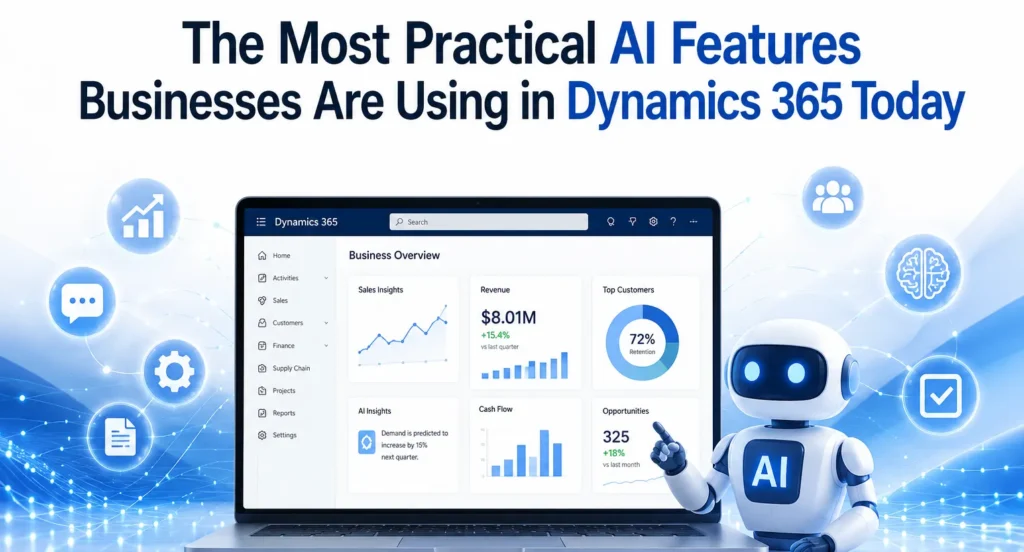
The Most Practical AI Features Businesses Are Using in Dynamics 365 Today
Artificial Intelligence (AI) has evolved from being a futuristic concept into a practical business tool that delivers measurable value. Organizations across manufacturing, retail, finance, healthcare, logistics, and professional services are no longer experimenting with AI—they are integrating it into their daily operations to improve productivity, automate repetitive tasks, and make faster business decisions. One platform leading this transformation is Microsoft Dynamics 365. With built-in AI capabilities and Microsoft Copilot, Dynamics 365 helps businesses simplify complex processes without requiring advanced technical expertise. Whether it’s generating financial reports, predicting customer demand, automating customer service responses, or improving inventory planning, AI is making enterprise resource planning (ERP) and customer relationship management (CRM) smarter than ever. Businesses working with an experienced Microsoft Dynamics 365 partner can implement these AI capabilities effectively, ensuring they align with organizational goals while maximizing return on investment. Why AI Matters in Dynamics 365 Traditional ERP systems were designed primarily to store and process business data. Modern Dynamics 365 solutions go much further by interpreting data, identifying patterns, and providing intelligent recommendations. Instead of manually analysing thousands of transactions or customer interactions, AI can instantly highlight trends, detect anomalies, and recommend actions. This allows employees to focus on strategic work rather than repetitive administrative tasks. As organizations continue their digital transformation journey, AI has become one of the biggest competitive advantages available within the Microsoft ecosystem. Microsoft Copilot: The Everyday AI Assistant Microsoft Copilot is perhaps the most practical AI feature currently available across Dynamics 365 applications. Rather than replacing employees, Copilot assists them by automating routine work. Users can create reports, summarize meetings, draft emails, generate customer responses, and analyse business data using simple natural language prompts. For finance teams, Copilot helps generate financial summaries and variance analyses. Sales teams receive AI-generated customer insights, while customer service agents can quickly access suggested solutions based on previous support cases. Within Microsoft Dynamics 365 Business Central, Copilot simplifies accounting tasks, purchasing processes, inventory management, and financial reporting, making ERP more accessible for users without technical expertise. AI-Powered Financial Management Finance departments spend countless hours reconciling accounts, preparing reports, reviewing invoices, and forecasting cash flow. AI dramatically reduces this workload. Dynamics 365 can automatically: Instead of spending days preparing month-end reports, finance teams can focus on analysing business performance and identifying growth opportunities. Organizations using professional Microsoft Dynamics 365 Support Services also benefit from continuous optimization as Microsoft regularly introduces new AI capabilities and enhancements. Intelligent Demand Forecasting Inventory planning has traditionally relied on historical sales and manual estimates. AI transforms this process by analysing multiple variables simultaneously. Dynamics 365 evaluates: The result is more accurate inventory forecasting, helping businesses reduce excess stock while avoiding costly stock shortages. Manufacturers and retailers especially benefit from AI-driven forecasting because it improves procurement decisions and production planning. Smarter Customer Service Customer expectations continue to rise, and businesses must deliver faster, more personalized support. AI within Dynamics 365 Customer Service enables organizations to: Support agents spend less time searching for information and more time resolving customer issues. Companies implementing these capabilities through experienced MS Dynamics 365 Implementation services often see improvements in customer satisfaction while reducing service costs. Sales Intelligence That Improves Conversions Sales professionals often struggle to identify which opportunities deserve immediate attention. Dynamics 365 Sales uses AI to prioritize leads based on customer behaviour, purchasing history, communication frequency, and engagement levels. Sales representatives receive recommendations such as: Instead of relying solely on instinct, sales teams can make data-driven decisions that improve conversion rates and increase revenue. AI in Supply Chain Management Supply chain disruptions have become increasingly common. AI helps businesses anticipate potential issues before they become serious problems. Dynamics 365 Supply Chain Management uses AI to: These predictive capabilities help organizations maintain business continuity while reducing operational costs. Businesses planning D365 migration services from legacy ERP systems often prioritize these AI-enabled supply chain features because they deliver immediate operational improvements. Automated Business Insights One of AI’s greatest strengths is transforming raw data into actionable insights. Executives no longer need to wait for manually prepared reports. Instead, AI continuously monitors business performance and alerts decision-makers about significant changes. Examples include: This proactive approach enables faster decision-making and more effective strategic planning. AI-Driven Purchasing and Procurement Procurement teams benefit from AI through improved supplier analysis and purchasing recommendations. Dynamics 365 can evaluate supplier performance, compare historical pricing, identify purchasing trends, and recommend optimal reorder quantities. This reduces procurement costs while improving supplier relationships and ensuring consistent product availability. Document Automation Businesses process thousands of documents every year, including invoices, purchase orders, contracts, receipts, and shipping documents. AI helps automate document processing by: This significantly reduces administrative work while minimizing human error. Predictive Maintenance Manufacturing companies using Dynamics 365 can leverage AI for predictive maintenance. Instead of repairing equipment after failure, AI analyses machine data to predict maintenance requirements before breakdowns occur. Benefits include reduced downtime, lower maintenance costs, longer equipment life, and improved production efficiency. Why Expert Implementation Matters Although Dynamics 365 includes powerful AI capabilities, achieving successful outcomes requires proper planning, customization, and integration. Working with experienced Microsoft Dynamics consulting services ensures businesses configure AI features according to their industry requirements, business processes, and long-term objectives. Professional consultants also help organizations integrate Microsoft 365, Power Platform, Azure AI, and other Microsoft technologies to create a connected digital ecosystem. Preparing for the Future Microsoft continues investing heavily in AI innovation across Dynamics 365. As Copilot evolves, businesses can expect even greater automation, more accurate predictions, and deeper business insights. Organizations that begin adopting AI today will be better positioned to respond to changing customer expectations, market conditions, and competitive pressures. Whether improving finance, supply chain, customer service, or sales, practical AI within Dynamics 365 is already delivering measurable business value across industries. Companies that embrace these capabilities with the guidance of a trusted implementation partner can achieve higher productivity, smarter decision-making, and sustainable long-term growth. Conclusion AI is no longer an optional technology for forward-thinking organizations. It has become a practical tool that improves
The Most Practical AI Features Businesses Are Using in Dynamics 365 Today Read More »