nav upgrade to business central

connected-factories-using-d365-to-optimize-production-efficiency

Connected Factories: Using D365 to Optimize Production Efficiency

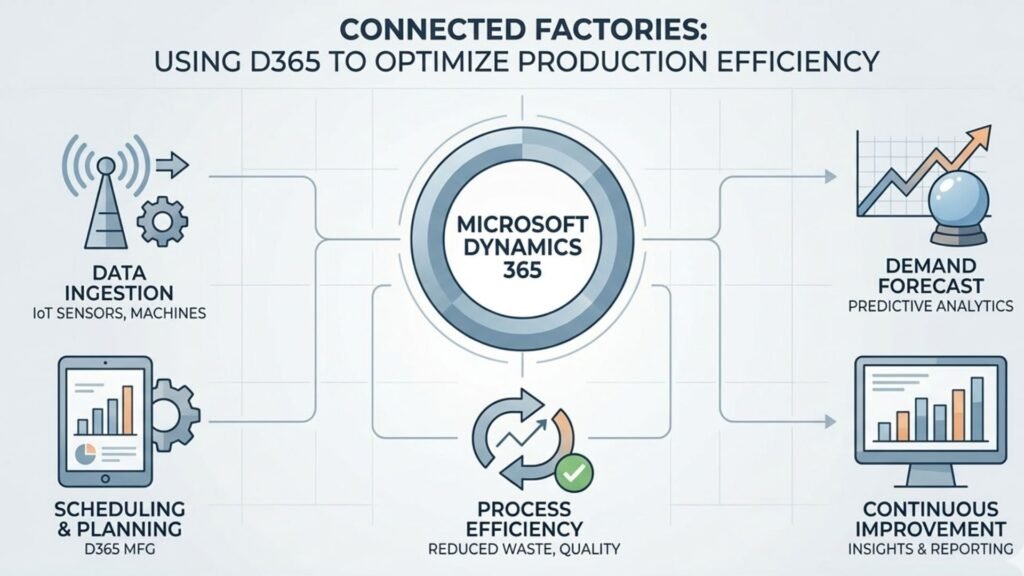
Microsoft Dynamics 365 (D365) transforms traditional factories into connected, intelligent operations by integrating ERP, real-time data analytics, and AI-driven insights. This article explores how D365 optimizes production efficiency, highlights key services like Microsoft Dynamics 365 partner in Texas USA, and addresses common implementation needs for manufacturers. The Rise of Connected Factories Connected factories leverage IoT sensors, cloud computing, and unified data platforms to create seamless production environments. D365 serves as the backbone, uniting supply chain management, finance, and operations into a single ecosystem. Manufacturers using D365 report up to 30% gains in production efficiency through real-time visibility into assets and workflows. By synchronizing physical machines with digital twins, downtime is reduced significantly, enabling predictive maintenance. This shift empowers Texas-based factories to compete globally, especially with localized Microsoft Dynamics 365 Business Central in Texas, USA deployments tailored for regional compliance and scalability. D365’s Core Modules for Manufacturing D365 Supply Chain Management handles production planning, inventory, and quality control with advanced tools like mixed reality guides. Business Central offers a lightweight ERP for small to mid-sized factories, focusing on affordability and quick setup. Key features include bills of materials (BOMs), routings, and production orders that automate scheduling. Integration with Power BI provides dashboards for monitoring KPIs like overall equipment effectiveness (OEE). For Texas manufacturers, Microsoft Dynamics 365 Support Services in Texas, USA ensure 24/7 uptime, critical for high-volume sectors like aerospace and automotive. Optimizing Production with Real-Time Asset Management D365 creates a ‘connected factory’ by streaming IoT data from machines to the cloud, enabling proactive issue resolution. Streamlined asset management tracks equipment health, preventing breakdowns before they impact output. Factories gain visibility into maintenance schedules, spare parts inventory, and performance trends. This reduces unplanned downtime by 20-50%, directly boosting throughput. Microsoft Dynamics 365 partners in Texas, USA, firms specialize in customizing these features for local industries, integrating with legacy PLC systems common in Texas oil and manufacturing hubs. Streamlining Supply Chain and Inventory D365 unifies procurement, warehousing, and production, minimizing stockouts and overstock. Demand forecasting powered by AI analyzes historical data and market trends for precise planning. Warehouse management tools support RFID and barcode scanning for real-time inventory accuracy. This connectivity extends to suppliers, fostering collaborative planning. In Texas, MS Dynamics 365 Implementation services in Texas USA accelerate these integrations, often completing projects in 3-6 months for mid-sized operations. Enhancing Quality Control and Compliance Production efficiency hinges on quality. D365’s quality management module automates inspections, non-conformance tracking, and corrective actions. Integration with Dynamics 365 Guides uses mixed reality for worker training, reducing errors. Compliance reporting for FDA, ISO, or Texas-specific regulations becomes automated, with audit trails embedded in every transaction. This ensures factories meet stringent standards without manual overhead. D365 migration services in Texas USA help legacy users transition smoothly, preserving data integrity during upgrades. AI and Predictive Analytics in Action Copilot in D365 applies generative AI to suggest optimizations, like rerouting production based on machine learning predictions. Sales and operations planning (S&OP) aligns forecasts with capacity in real-time. For connected factories, this means adaptive scheduling that responds to disruptions like supply delays. Texas consultants excel in embedding these AI tools into custom workflows. Microsoft Dynamics consulting services in Texas USA often bundle AI training, ensuring teams maximize tools like Customer Insights for demand sensing. Cost Savings and ROI Metrics Implementing D365 yields measurable ROI: 15-25% inventory reduction, 10-20% faster cycle times, and lower operational costs. Cloud scalability eliminates CapEx on hardware, with pay-as-you-go licensing. Texas manufacturers benefit from a regional Microsoft Dynamics 365 partner in Texas, USA, and incentives, including subsidies for digital transformation initiatives. Metric Pre-D365 Average Post-D365 Improvement Downtime 10-15% of shifts Reduced by 40% ​ Inventory Costs $500K/year 25% lower Production Speed Baseline 20% faster OEE Score 75% Up to 90% Texas-Specific D365 Ecosystem Texas hosts a robust network of certified partners specializing in manufacturing. Microsoft Dynamics 365 Business Central in Texas USA is popular for its mid-market fit, supporting discrete and process manufacturing. Firms offer end-to-end services, from initial audits to post-go-live optimization. Proximity reduces travel costs and enables on-site support. Microsoft Dynamics 365 Support Services in Texas USA include managed services for peak seasons, vital for energy and food processing sectors. Implementation Roadmap Successful D365 rollout follows phases: assessment, design, build, test, deploy, and optimize. MS Dynamics 365 Implementation services in Texas USA streamline this, leveraging local expertise for faster value realization. Case Studies: Texas Manufacturers A Houston discrete manufacturer adopted D365 Supply Chain, cutting lead times by 35% via connected factory IoT integrations. Another in Dallas used Business Central for mixed-mode production, achieving 28% efficiency gains. These successes highlight D365 migration services in Texas, USA, where partners handle complex data transfers from SAP or older ERPs. Microsoft Dynamics consulting services in Texas, USA, provided the roadmap, including custom Power Automate flows for approvals. Challenges and Mitigation Strategies Common hurdles include change resistance and integration complexity. Address with phased adoption and executive sponsorship. Data quality issues pre-migration require cleansing tools. Texas partners offer pre-implementation audits to de-risk projects. Ongoing Microsoft Dynamics 365 Support Services in Texas USA provide helpdesk and proactive monitoring. Future-Proofing with Extensibility D365’s low-code platform allows custom apps via Power Platform. Fabric integration brings advanced analytics for GenAI-driven insights. Texas factories are preparing for Industry 5.0 by extending D365 to edge devices to ensure long-term scalability. Related FAQs Q1. What is a connected factory in D365?Ans: A connected factory uses D365 to link IoT devices, ERP data, and AI for real-time optimization, reducing downtime and enhancing visibility.​ Q2. How does Microsoft Dynamics 365 Business Central support manufacturing?Ans: It handles BOMs, routings, production orders, and integrates with Power BI for insights, ideal for mid-sized Texas operations.​ Q3. Differences between D365 and Microsoft 365?Ans: D365 focuses on ERP/CRM, like Finance and Sales; Microsoft 365 is productivity tools like Office apps. They integrate seamlessly via Azure.​ Q4. What services do Microsoft Dynamics 365 partners in Texas USA offer?Ans: Implementation, migration, support, consulting, and custom development for local compliance and efficiency.​ Q5. How long does D365 implementation

Connected Factories: Using D365 to Optimize Production Efficiency Read More »

future-proofing-your-business-with-a-d365-f-o-upgrade

Future-Proofing Your Business with a D365 F&O Upgrade

In today’s rapidly evolving digital economy, businesses in Texas are under increasing pressure to modernize their ERP systems. Legacy platforms can no longer keep up with growing operational complexity, regulatory changes, and customer expectations. That’s where upgrading to Microsoft Dynamics 365 Finance & Operations (D365 F&O) becomes a strategic advantage. Whether you are working with a microsoft dynamics 365 partner in texas usa or planning your digital transformation roadmap, upgrading to D365 Finance & Operations is more than a technical shift — it is a long-term investment in scalability, agility, and innovation. This comprehensive guide explores why a D365 F&O upgrade is critical, its key benefits, implementation strategies, and how businesses can future-proof operations with the right approach. Understanding D365 Finance & Operations Microsoft Dynamics 365 Finance and Microsoft Dynamics 365 Supply Chain Management (formerly part of Dynamics 365 Finance & Operations) are enterprise-grade ERP solutions designed for medium to large organizations. Built on Microsoft’s cloud ecosystem, they provide advanced capabilities for: Unlike traditional ERP systems, D365 F&O is cloud-first, AI-powered, and continuously updated — ensuring your system never becomes outdated. Why Texas Businesses Need to Upgrade Texas is home to thriving industries including manufacturing, oil & gas, retail, healthcare, logistics, and professional services. These industries face: An outdated ERP system limits visibility and slows decision-making. Upgrading with D365 migration services in texas usa ensures organizations remain competitive and compliant while scaling efficiently. Key Benefits of a D365 F&O Upgrade 1. Cloud-Based Scalability One of the biggest advantages of D365 F&O is its cloud infrastructure. Powered by Microsoft Azure, it enables: With support from Microsoft Dynamics 365 Support Services in texas usa, businesses can maintain optimal system performance while focusing on growth. 2. Advanced Financial Management D365 Finance provides: For CFOs in Texas-based enterprises, this means improved transparency and faster strategic decisions. 3. Intelligent Supply Chain Optimization Supply chain volatility is a major challenge across industries. D365 Supply Chain Management helps by offering: Organizations leveraging MS Dynamics 365 Implementation services in texas usa can integrate end-to-end supply chain visibility to prevent costly disruptions. 4. Data-Driven Decision Making D365 F&O integrates seamlessly with: These integrations allow executives to: Data becomes actionable rather than static. 5. Enhanced Compliance and Security Texas industries such as healthcare, energy, and finance require strict compliance. D365 F&O offers: Cloud security from Microsoft ensures enterprise-grade protection against cyber threats. 6. Improved Operational Efficiency Automation reduces manual workloads across departments: Businesses working with a microsoft dynamics consulting services in texas usa provider can tailor automation processes to match industry-specific requirements. Signs Your Business Needs a D365 F&O Upgrade You should consider upgrading if: If your organization is still running legacy Dynamics AX or on-premise ERP systems, now is the time to evaluate a cloud transition. D365 F&O vs. Business Central: What’s the Difference? Many companies explore both Finance & Operations and Business Central. Microsoft Dynamics 365 Business Central is ideal for small to mid-sized businesses, while D365 Finance & Operations is better suited for: Organizations looking for microsoft dynamics 365 business central in texas usa often transition to F&O when their operations expand beyond mid-market limitations. The Upgrade Process: Step-by-Step 1. Assessment & Planning Partnering with a reliable microsoft dynamics 365 partner in texas usa ensures a strategic roadmap aligned with business goals. 2. Data Migration Strategy Data cleansing and preparation are critical. A structured migration plan ensures: Professional D365 migration services in texas usa help avoid data inconsistencies. 3. System Configuration & Customization Tailoring D365 F&O to match industry-specific workflows ensures maximum efficiency. Customization areas include: 4. Testing & Validation Before going live: This phase prevents post-implementation disruptions. 5. Training & Support Change management is key. Employees must: Ongoing Microsoft Dynamics 365 Support Services in texas usa ensure long-term system success. Industry-Specific Advantages in Texas Manufacturing Oil & Gas Retail & Distribution Professional Services ROI of a D365 F&O Upgrade Businesses often see ROI through: A strategic upgrade pays off within 12–24 months for many enterprises. Common Upgrade Challenges (And How to Overcome Them) 1. Resistance to Change Solution: Structured training and leadership alignment. 2. Data Complexity Solution: Early data cleansing and migration audits. 3. Budget Constraints Solution: Phased implementation strategy. 4. Integration Issues Solution: Work with experienced consultants specializing in microsoft dynamics consulting services in texas usa. Future Trends in D365 F&O Upgrading ensures you stay aligned with Microsoft’s innovation roadmap. Why Choose the Right Partner in Texas? Selecting the right partner ensures: A trusted microsoft dynamics 365 partner in texas usa brings local expertise, regulatory knowledge, and industry best practices. Conclusion Future-proofing your business is not about reacting to change — it’s about preparing for it. A D365 F&O upgrade empowers Texas enterprises to operate with agility, insight, and resilience. From finance automation to intelligent supply chains, the benefits extend far beyond software modernization. With expert MS Dynamics 365 Implementation services in texas usa, structured D365 migration services in texas usa, and ongoing Microsoft Dynamics 365 Support Services in texas usa, organizations can confidently scale and innovate. The future belongs to businesses that adapt. Upgrading to D365 Finance & Operations is your step toward sustainable growth. Frequently Asked Questions (FAQs) Q1. How long does a D365 F&O upgrade take? Ans: Implementation timelines vary depending on business complexity. Typically, mid-to-large enterprises require 6–12 months for a complete upgrade. Q2. Is D365 F&O suitable for mid-sized businesses? While designed for larger enterprises, growing mid-sized businesses with complex operations may also benefit. Smaller organizations often start with Business Central. 3. What is the difference between implementation and migration services? Ans: Implementation focuses on deploying a new system. Migration services involve transferring data and processes from a legacy ERP to D365 F&O. Q4. How secure is D365 Finance & Operations? Ans: It runs on Microsoft Azure, offering enterprise-grade security, compliance certifications, encryption, and continuous monitoring. Q5. Can D365 F&O integrate with third-party applications? Ans: Yes. It supports APIs and integrates seamlessly with Microsoft tools and third-party platforms. Q6. What industries benefit most from upgrading? Ans: Manufacturing, distribution, oil

Future-Proofing Your Business with a D365 F&O Upgrade Read More »

from-reactive-to-predictive-the-future-of-erp-managed-services

From Reactive to Predictive: The Future of ERP Managed Services

In today’s hyper-competitive digital economy, businesses can no longer afford to operate in a reactive mode. Waiting for systems to fail before fixing them is not just outdated—it’s expensive. Enterprise Resource Planning (ERP) has evolved far beyond back-office automation. With intelligent tools like Microsoft Dynamics 365, ERP managed services are shifting from reactive support to predictive intelligence. Organizations across industries are now embracing predictive ERP managed services to minimize downtime, optimize performance, and unlock real-time business insights. Especially for businesses looking for a microsoft dynamics 365 partner in texas usa, the shift to predictive services is becoming a strategic necessity rather than a technical upgrade. Let’s explore how ERP managed services are evolving—and why forward-thinking businesses are making the move now. The Traditional Reactive ERP Model: A Costly Approach For years, ERP support operated on a “break-fix” model. Something failed. The IT team responded. Business operations suffered in the meantime. This reactive approach often leads to: While reactive ERP support may appear cost-effective initially, hidden costs accumulate quickly. Missed sales, delayed supply chains, and frustrated employees can significantly impact profitability. What Does Predictive ERP Managed Services Mean? Predictive ERP managed services leverage AI, automation, real-time monitoring, and analytics to detect potential issues before they impact operations. With solutions like Microsoft Dynamics 365 Business Central, organizations can: Instead of reacting to problems, businesses anticipate and prevent them. Why Predictive ERP Is the Future 1. Reduced Downtime Downtime is one of the biggest risks to modern enterprises. Predictive monitoring tools continuously track system performance and alert teams before failures occur. 2. Enhanced Security Cyber threats are growing in sophistication. Predictive ERP systems analyze unusual activity patterns and flag security risks before breaches happen. 3. Smarter Decision-Making With built-in analytics and AI-driven insights, businesses gain access to actionable data that supports faster and more accurate decision-making. 4. Improved ROI Predictive services reduce emergency interventions and costly disruptions. Over time, this significantly improves ERP ROI. The Role of a Microsoft Dynamics 365 Partner in Texas USA Choosing the right microsoft dynamics 365 partner in texas usa is critical for transitioning from reactive to predictive ERP services. A reliable partner provides: Local expertise in Texas ensures compliance with regional regulations, faster response times, and personalized support tailored to your business environment. Microsoft Dynamics 365 Business Central in Texas USA: Driving Intelligent Operations Businesses implementing microsoft dynamics 365 business central in texas usa are gaining access to cloud-powered intelligence that supports predictive management. Key capabilities include: This cloud-based ERP solution integrates seamlessly with other Microsoft tools, enabling data-driven operations across departments. Microsoft Dynamics 365 Support Services in Texas USA Ongoing support is where predictive ERP truly shines. With comprehensive Microsoft Dynamics 365 Support Services in texas usa, businesses benefit from: Instead of waiting for system failures, support teams actively monitor and optimize your ERP environment. MS Dynamics 365 Implementation Services in Texas USA Successful ERP transformation begins with a strategic implementation approach. Professional MS Dynamics 365 Implementation services in texas usa ensure: A predictive mindset starts at implementation. When systems are architected for scalability and automation from day one, long-term performance improves dramatically. D365 Migration Services in Texas USA: Moving to the Cloud Legacy systems limit predictive capabilities. Modern businesses are investing in D365 migration services in texas usa to move from on-premise or outdated ERP systems to cloud-based platforms. Cloud migration enables: Migration is not just a technical change—it’s a strategic shift toward future-ready operations. Microsoft Dynamics Consulting Services in Texas USA Transitioning to predictive ERP requires expertise beyond technical support. Businesses benefit from professional microsoft dynamics consulting services in texas usa to: Consultants help organizations unlock the full potential of predictive capabilities within Dynamics 365. Key Technologies Powering Predictive ERP Predictive ERP managed services rely on advanced technologies such as: Artificial Intelligence (AI) : AI algorithms analyze historical data to forecast future outcomes, detect anomalies, and optimize processes. Machine Learning : Systems continuously improve by learning from operational data patterns. Cloud Computing : Cloud platforms provide scalability, flexibility, and continuous updates. Advanced Analytics: Real-time dashboards transform raw data into actionable insights. Industry Benefits of Predictive ERP Managed Services Manufacturing : Predictive maintenance reduces equipment downtime and optimizes production schedules. Retail: Demand forecasting improves inventory planning and customer satisfaction. Healthcare : Real-time compliance monitoring enhances patient data security. Financial Services : Risk management becomes proactive rather than reactive. Measuring Success: KPIs for Predictive ERP Organizations transitioning to predictive ERP should monitor: Improved metrics confirm the effectiveness of predictive managed services. Challenges in Moving from Reactive to Predictive Despite its advantages, transformation can present challenges: Partnering with an experienced Dynamics 365 provider helps overcome these barriers efficiently. The Financial Impact of Predictive ERP Reactive ERP support often results in hidden losses. Predictive ERP, however, creates measurable financial benefits: The long-term savings typically outweigh the initial investment in predictive services. Building a Predictive ERP Strategy To successfully transition: Working with a trusted partner in Texas ensures structured and strategic transformation. Why Businesses in Texas Are Accelerating ERP Modernization Texas is home to rapidly growing industries, including technology, manufacturing, healthcare, and retail. These sectors demand scalable and intelligent ERP systems. Businesses searching for a microsoft dynamics 365 partner in texas usa are prioritizing predictive managed services to remain competitive and future-ready. Conclusion: The Future Is Predictive, Not Reactive ERP managed services are no longer just about fixing problems—they’re about preventing them. The evolution from reactive to predictive represents a fundamental shift in how businesses operate. With solutions like Microsoft Dynamics 365 and expert Microsoft Dynamics 365 Support Services in texas usa, companies can: Organizations that embrace predictive ERP today will lead their industries tomorrow. Frequently Asked Questions (FAQs) Q 1. What is predictive ERP managed services? Ans: Predictive ERP managed services use AI, monitoring tools, and analytics to prevent system issues before they impact operations. Q 2. Why should I choose a microsoft dynamics 365 partner in texas usa? Ans: A local partner offers faster response times, regional expertise, compliance understanding, and personalized support tailored to your

From Reactive to Predictive: The Future of ERP Managed Services Read More »

align-your-business-goals

How to Align Your Business Goals with a D365 Implementation Strategy

In today’s fast-evolving digital economy, businesses face the constant challenge of aligning technology with strategy. While enterprise resource planning (ERP) systems have long been the backbone of efficient operations, not all implementations deliver the results organizations envision. Microsoft Dynamics 365 (D365), however, offers a unique opportunity — it integrates finance, operations, sales, and customer engagement on a unified platform that adapts to your business goals. Yet, even the most robust ERP platform can fall short without a well-aligned implementation strategy. Whether you’re a mid-sized enterprise or a large organization in Texas, aligning your D365 implementation strategy with your core business objectives is crucial for driving ROI, productivity, and long-term growth. In this guide, we’ll explore how to strategically align your business goals with Microsoft Dynamics 365, key steps in planning your implementation, and why partnering with a Microsoft Dynamics 365 partner in Texas, USA ensures your project’s success. Understanding the Power of Microsoft Dynamics 365 Microsoft Dynamics 365 isn’t just an ERP or CRM — it’s a connected business solution designed to unify data, people, and processes. The platform helps organizations improve visibility, streamline workflows, and make smarter, data-driven decisions. Some of its key features include: However, to unlock the full potential of Microsoft Dynamics 365, organizations must ensure the implementation aligns with their strategic direction — not the other way around. Step 1: Define Clear Business Goals Before Implementation A successful ERP implementation begins with clarity of purpose. Before deploying Microsoft Dynamics 365, leadership teams should define measurable goals that reflect their business priorities. Ask these essential questions: For instance, if your goal is to improve supply chain efficiency, you might focus on Dynamics 365 modules like Supply Chain Management and Finance, integrating predictive analytics to reduce bottlenecks. If customer engagement is a top priority, the Dynamics 365 Customer Service and Sales modules can help enhance customer experiences and retention. A Microsoft Dynamics 365 partner in Texas, USA can work with your leadership and technical teams to translate these goals into system configurations that directly support your KPIs. Step 2: Conduct a Comprehensive Business Process Assessment Before any ERP implementation, a deep understanding of existing workflows and inefficiencies is essential. Many organizations make the mistake of automating flawed processes, which can magnify problems instead of solving them. An ERP consulting services provider in Texas, USA will typically conduct a process mapping and gap analysis that involves: This discovery phase ensures the implementation aligns with real operational needs — not assumptions. Step 3: Choose the Right Dynamics 365 Applications Microsoft Dynamics 365 offers modular apps tailored to different business functions. Selecting the right combination of apps is key to aligning technology with your strategy. Here’s a quick overview of key modules and how they relate to business objectives: Business Goal Recommended D365 Module Strategic Outcome Financial visibility and compliance Dynamics 365 Finance Real-time insights and automated reporting Streamlined operations and supply chain Dynamics 365 Supply Chain Management End-to-end logistics optimization Improved sales and customer engagement Dynamics 365 Sales & Customer Service Better forecasting and customer loyalty Project management and delivery Dynamics 365 Project Operations Resource optimization and profitability Efficient HR management Dynamics 365 Human Resources Enhanced employee engagement and compliance A certified Microsoft Dynamics 365 services provider in Texas, USA can help you identify which apps align best with your short- and long-term business goals, ensuring a cost-effective and scalable deployment. Step 4: Align Stakeholders and Build a Change Management Plan Technology alone doesn’t drive transformation — people do. An ERP implementation impacts every department, from finance and operations to HR and customer service. Therefore, early stakeholder involvement is critical. Here’s how to ensure alignment: An experienced ERP implementation services provider in Texas, USA will integrate change management into the project plan, ensuring smoother adoption and long-term sustainability. Step 5: Data Strategy – The Foundation of Your D365 Implementation Data is the backbone of any ERP system. Before migration, businesses must assess data quality, structure, and accessibility. Poor data can derail even the most well-planned implementation. Key steps include: Partnering with a Microsoft Dynamics 365 partner in Texas, USA ensures your data strategy adheres to Microsoft’s best practices and supports analytics-driven decision-making post-implementation. Step 6: Establish KPIs and Measurement Metrics To ensure your implementation aligns with business objectives, define Key Performance Indicators (KPIs) early in the process. Common ERP-related KPIs include: Microsoft Dynamics 365’s embedded analytics and Power BI integration allow organizations to track these KPIs in real-time. When implemented strategically, the system becomes a tool not only for automation but also for continuous improvement. Step 7: Leverage Expert Guidance from a Certified Partner The complexity of an ERP implementation demands both technical and strategic expertise. A Microsoft Dynamics 365 partner in Texas, USA brings local industry knowledge, certified resources, and proven methodologies to ensure success. Here’s how the right partner adds value: By choosing a trusted partner offering ERP consulting services in Texas, USA, you ensure that your D365 solution evolves as your business does. Step 8: Adopt a Phased Implementation Approach A phased rollout allows you to deploy D365 modules in stages, reducing risk and improving user adoption. For example: Each phase includes testing, feedback, and process adjustments before expanding further. This agile methodology ensures alignment remains strong throughout the implementation lifecycle. Step 9: Ensure Continuous Optimization Post-Implementation ERP implementation is not a one-time event — it’s a continuous journey. Once Microsoft Dynamics 365 is live, ongoing optimization is key to keeping the system aligned with evolving business goals. Areas to focus on include: A reliable Microsoft Dynamics 365 services provider in Texas, USA will offer post-implementation support, monitoring performance, and recommending enhancements to maximize ROI. Step 10: Leverage the Power of Integration and Automation To truly align D365 with your goals, consider integrating it with other business applications — such as Power BI for analytics, Microsoft Power Apps for automation, and Teams for collaboration. These integrations allow seamless data flow across your enterprise ecosystem, reducing manual effort and improving productivity. Over time, you can automate recurring

How to Align Your Business Goals with a D365 Implementation Strategy Read More »

food-company

Food and Beverage Companies Transform Traceability and Recalls with Microsoft Dynamics 365

In the food and beverage (F&B) industry, precision, quality control, and compliance aren’t just operational goals — they’re survival factors. When a recall or contamination occurs, companies must act swiftly to identify the source, track affected batches, and ensure consumer safety. Modern technology plays a central role in this process, and Microsoft Dynamics 365 has become a trusted ally for many F&B manufacturers seeking total supply chain visibility and compliance management. From ingredient sourcing to distribution, Dynamics 365 delivers powerful capabilities for traceability, recall management, and quality assurance. Let’s explore how the platform empowers food and beverage companies to enhance their operations — and why working with an experienced Microsoft Dynamics 365 partner in Texas, USA, can make all the difference. 1. The Importance of Traceability and Recall Management in Food & Beverage Food and beverage businesses operate in one of the most highly regulated industries in the world. Agencies like the FDA (Food and Drug Administration) and USDA (United States Department of Agriculture) enforce stringent regulations for labeling, traceability, and product safety. A single labeling error, contamination event, or supplier issue can result in: To mitigate these risks, companies need real-time visibility across their entire supply chain. This includes knowing where raw materials come from, where they go, and how they’re processed at every stage. Manual systems and spreadsheets simply cannot manage this complexity anymore. That’s where Microsoft Dynamics 365 provides a complete, unified ERP platform designed for end-to-end transparency. 2. How Dynamics 365 Strengthens Traceability a. End-to-End Ingredient Tracking With Dynamics 365 Supply Chain Management, every ingredient can be traced from the supplier to the shelf. Each item receives a unique batch or lot number, enabling companies to track: This level of visibility ensures that if contamination or quality issues arise, affected batches can be quickly identified and isolated without halting entire operations. b. Real-Time Data Synchronization Unlike legacy ERP systems that work in silos, Dynamics 365 integrates financials, supply chain, production, and quality management into one unified platform. Real-time data flows allow manufacturers to: Companies leveraging Microsoft Dynamics 365 consulting services in Texas, USA can also customize these workflows to fit their specific traceability requirements — ensuring compliance with both local and international standards. c. Integration with IoT and AI Microsoft’s cloud-first approach means Dynamics 365 integrates seamlessly with IoT sensors and AI analytics. For example: This predictive approach transforms traditional quality assurance into proactive management — a key advantage in minimizing recall risks. 3. Efficient Recall Management with Dynamics 365 Even with the best preventive measures, recalls can still occur. Dynamics 365 provides robust features to execute recalls efficiently while minimizing disruption. a. Rapid Identification of Affected Batches When a potential issue is detected, the system allows for instant identification of all affected products — including where they were shipped and which customers received them. This is crucial for reducing the impact of recalls and maintaining compliance with FDA reporting requirements. b. Automated Notifications and Documentation Dynamics 365 automates critical recall steps such as: These workflows ensure that recalls are executed faster, with full audit trails, reducing administrative burden. c. Post-Recall Analysis After a recall, Dynamics 365 enables companies to perform root-cause analysis by reviewing the data trail. They can analyze supplier performance, production logs, and inspection results to prevent similar issues in the future. Engaging a Microsoft Dynamics 365 partner in Texas, USA, helps businesses set up these analytical dashboards and automate preventive actions based on recall data. 4. Quality and Compliance Made Easy a. Built-in Quality Control Quality checkpoints can be embedded throughout the production lifecycle — from receiving raw materials to final packaging. Dynamics 365 Business Central or Dynamics 365 Supply Chain Management enables automatic holds on items that fail inspection, preventing defective products from reaching consumers. b. Regulatory Compliance Dynamics 365 supports compliance with multiple global food safety standards, including: By maintaining complete digital records and audit trails, the system helps ensure smooth compliance audits and reporting. c. Allergen and Label Management For food producers, managing allergen information and accurate labeling is non-negotiable. Dynamics 365 streamlines this by linking ingredient data directly with packaging and labeling workflows — ensuring correct labeling, fewer errors, and full transparency. 5. Benefits of Using Microsoft Dynamics 365 for the F&B Industry a. Unified Data and Visibility With Dynamics 365, food manufacturers can unify operations — from production to finance — into a single, cloud-based solution. This eliminates data silos and provides real-time visibility into every process. b. Improved Operational Efficiency Automating manual processes like tracking, inspections, and reporting reduces human error and accelerates production cycles. c. Enhanced Consumer Trust Consumers today demand transparency. Having a digital trail of every ingredient and production step fosters trust and strengthens brand reputation. d. Better Collaboration Across Departments Because Dynamics 365 integrates with tools like Microsoft Teams and Power BI, teams can collaborate seamlessly, share dashboards, and make quick, informed decisions. e. Scalable and Flexible Platform As your business grows, Dynamics 365 scales effortlessly — supporting multiple locations, warehouses, and international operations without compromising performance. 6. How ERP Migration Services in Texas, USA, Help You Transition to Dynamics 365 For many F&B companies still using outdated systems like NAV, GP, or AX, migrating to Dynamics 365 is not just a technology upgrade — it’s a strategic move toward modernization. Expert ERP Migration Services in Texas, USA, ensure a smooth transition by: Working with a trusted Microsoft Dynamics 365 partner in Texas, USA, ensures your migration project is executed efficiently, meeting both operational and compliance goals. 7. The Role of ERP Consulting Services in Texas, USA ERP consulting is vital for ensuring your system supports your business model. ERP Consulting Services in Texas, USA, can help you: Consultants with food industry expertise can also guide you on best practices for FDA compliance and sustainability initiatives. 8. Continuous Optimization with Microsoft Dynamics 365 Support Services in Texas, USA Once your Dynamics 365 system is live, ongoing support becomes essential to keep operations running smoothly. Reliable Microsoft Dynamics 365 Support Services in

Food and Beverage Companies Transform Traceability and Recalls with Microsoft Dynamics 365 Read More »

cloud-vs-on-premises-erp

Cloud vs. On-Premises ERP: What’s Best for Your Business

In today’s fast-changing business environment, Enterprise Resource Planning (ERP) systems have become the backbone of modern organizations. They help integrate finance, operations, supply chain, HR, and customer management into a single system that provides real-time insights and supports better decision-making. But when it comes to deploying ERP software, companies often face a crucial decision: Cloud ERP or On-Premises ERP? Each option has its advantages, challenges, and suitability depending on the size of your business, industry needs, and long-term strategy. This article provides an in-depth comparison between cloud and on-premises ERP, helping you decide what’s best for your organization. We’ll also highlight how a trusted Microsoft Dynamics 365 partner in Texas, USA can guide you through this journey. What is ERP and Why is Deployment Important? An ERP system streamlines business processes by integrating core functions like accounting, manufacturing, sales, procurement, and inventory management into one central system. Deployment—whether cloud-based or on-premises—determines how the ERP is installed, managed, and accessed. Choosing between the two impacts cost, flexibility, scalability, and security. Cloud ERP: An Overview Cloud ERP solutions like Microsoft Dynamics 365 Business Central are hosted on the vendor’s cloud infrastructure (e.g., Microsoft Azure). Businesses access them via web browsers or mobile apps, paying for usage through a subscription model. Advantages of Cloud ERP Challenges of Cloud ERP On-Premises ERP: An Overview With on-premises ERP, the system is installed on servers owned and maintained by your organization. Advantages of On-Premises ERP Challenges of On-Premises ERP Comparing Cloud vs. On-Premises ERP Criteria Cloud ERP (e.g., Business Central) On-Premises ERP Cost Lower upfront, subscription-based Higher upfront, ongoing maintenance Scalability Highly scalable Limited, requires hardware upgrades Deployment Time Fast (weeks to months) Longer (months to over a year) Customization Moderate, through extensions Deep customization possible Security Cloud-provider managed, high compliance Managed internally, depends on IT team Access Anywhere, any device Local network unless configured remotely Updates Automatic, regular Manual, may require downtime Which Option is Best for Your Business? The choice depends on your company’s needs, size, and budget: Why Microsoft Dynamics 365 Business Central is the Right Choice Microsoft Dynamics 365 Business Central is one of the most popular cloud ERP solutions, offering: Partnering with a trusted Dynamics 365 Business Central partner in Texas, USA ensures smooth implementation, tailored configurations, and ongoing support. The Role of Microsoft Dynamics 365 Partners in Texas, USA Selecting the right ERP system is only half the battle—the other half is successful implementation. A reliable Microsoft Dynamics 365 partner in Texas, USA provides: ERP Implementation Best Practices Cloud ERP in Texas: Growing Adoption In Texas, industries like oil & gas, manufacturing, retail, and healthcare are rapidly adopting cloud-based ERP systems. Companies want agility, cost savings, and resilience—especially after the challenges of global supply chain disruptions. With Microsoft Dynamics 365 Support Services in Texas, USA, businesses gain local expertise backed by Microsoft’s global infrastructure. FAQs Q 1. Which is more cost-effective: cloud ERP or on-premises ERP?Ans: Cloud ERP usually has lower upfront costs and predictable subscription fees, while on-premises requires high initial investment but may be cheaper in the very long run for large enterprises. Q 2. Can Microsoft Dynamics 365 Business Central be deployed on-premises?Ans: Yes, Business Central offers both cloud and on-premises deployment, giving businesses flexibility. Q 3. How secure is Cloud ERP?Ans: With Microsoft Azure hosting, Cloud ERP comes with enterprise-grade security, encryption, and compliance certifications. Q 4. How long does ERP implementation take?Ans: Cloud ERP like Business Central can be implemented in 3–6 months, while on-premises systems may take 9–12 months or longer. Q 5. Why choose a Dynamics 365 partner in Texas, USA?Ans: A local partner provides industry expertise, personalized support, and faster response times tailored to Texas-based businesses. Conclusion Deciding between cloud ERP and on-premises ERP depends on your business’s size, budget, and future goals. Cloud ERP offers flexibility, lower upfront costs, and faster deployment—ideal for growing companies that value agility. On-premises ERP offers greater control and customization but comes with higher costs and longer setup times. For many businesses in Texas, Microsoft Dynamics 365 Business Central provides the perfect balance of functionality, scalability, and affordability. Working with a trusted Microsoft Dynamics 365 partner in Texas, USA ensures that you get the right deployment model, seamless implementation, and reliable ongoing support. Whether you’re considering cloud or on-premises ERP, the key is to align your choice with your business strategy—and with the right partner, you can transform operations, boost productivity, and position your business for long-term success.

Cloud vs. On-Premises ERP: What’s Best for Your Business Read More »

microsoft-dynamics-support-partner

5 Questions to Ask Before Hiring a Microsoft Dynamics Support Partner

Microsoft Dynamics 365 has become a cornerstone solution for organizations across industries looking to streamline processes, improve productivity, and enhance customer engagement. However, implementing, maintaining, and optimizing Dynamics 365 is not always straightforward. Businesses require the expertise of a reliable Microsoft Dynamics Support Partner to ensure seamless operations and ongoing success. If your business is based in the U.S., particularly in Texas, finding the right Microsoft Dynamics 365 partners in Texas, USA is crucial. With so many providers offering MS Dynamics Implementation Services in Texas, USA, the decision can feel overwhelming. The key is to ask the right questions before committing to a partnership. This article outlines five critical questions you should ask when hiring a Microsoft Dynamics Support Partner in Texas, USA. 1. What Experience Do You Have in My Industry? Every industry—from manufacturing and retail to professional services—has unique needs. While most support partners claim they can manage Dynamics 365, the level of expertise varies greatly. By asking about industry-specific experience, you’ll uncover whether a potential partner has successfully handled businesses similar to yours. For example, manufacturers often require complex inventory and production tracking capabilities, while service providers need strong project management and customer engagement modules. A skilled Dynamics 365 Business Central Partner in Texas, USA with proven experience in your sector can configure, customize, and optimize the platform to align with your business objectives. What to look for: 2. What Support Models Do You Offer? Support needs vary from company to company. Some businesses require 24/7 support, while others might only need standard business-hour coverage. Understanding the partner’s support model is essential to ensure it aligns with your operational needs. A dependable Microsoft Dynamics Support Partner in Texas, USA should provide flexible options such as: Additionally, confirm whether support is offered remotely, on-site, or through a hybrid model. This ensures you can count on them in both routine and urgent scenarios. 3. Are You Certified Microsoft Dynamics 365 Partners? Microsoft certifications are a strong indicator of credibility and expertise. Certified partners undergo rigorous training and testing to prove their proficiency with Microsoft Dynamics 365 solutions. When evaluating Microsoft Dynamics 365 partners in Texas, USA, ask if they are officially recognized as a Microsoft Gold or Solutions Partner. This certification guarantees that the partner is up to date with the latest Dynamics 365 updates, tools, and best practices. Why it matters: Working with a certified partner provides peace of mind and ensures you’re getting the most value from your MS Dynamics Implementation Services in Texas, USA. 4. How Do You Approach Customization and Integration? Every business is unique, and “one-size-fits-all” solutions rarely deliver maximum value. The ability to customize Dynamics 365 and integrate it with other business applications is a must-have. A trusted Dynamics 365 Business Central Partner in Texas, USA will carefully analyze your processes and design solutions tailored to your needs. Whether it’s integrating Dynamics 365 with your ERP, CRM, e-commerce platform, or third-party apps, customization ensures that the system works seamlessly for you. Questions to ask here: Partners who can confidently answer these questions are more likely to help you unlock the full potential of your Dynamics investment. 5. What Is Your Long-Term Partnership Approach? Dynamics 365 is not a one-time implementation—it’s a long-term business enabler. You’ll need continuous support, upgrades, and guidance to adapt to evolving business challenges. The best Microsoft Dynamics Support Partner in Texas, USA won’t just provide technical assistance; they will become a trusted advisor. Look for a partner who: Their ability to align with your strategic vision ensures that Dynamics 365 continues to deliver value year after year. Benefits of Hiring the Right Microsoft Dynamics Support Partner Partnering with the right provider offers significant advantages: Why Texas Businesses Need a Reliable Dynamics Partner Texas is home to diverse industries—oil & gas, healthcare, manufacturing, technology, and retail—all of which require agile, data-driven solutions. Choosing the right MS Dynamics Implementation Services in Texas, USA means gaining a partner who understands local business landscapes, compliance rules, and growth opportunities. A Texas-based Dynamics 365 Business Central Partner in Texas, USA can provide tailored solutions that fit your market demands while ensuring fast, reliable support. Whether you’re migrating from legacy systems or optimizing existing Dynamics deployments, local expertise is invaluable. FAQs Q 1: Why should I choose a Microsoft Dynamics Support Partner in Texas, USA instead of offshore providers?Ans: A local partner ensures faster response times, a better understanding of U.S. business regulations, and face-to-face collaboration opportunities that offshore providers may not always offer. Q 2: What’s the difference between Microsoft Dynamics Support and Implementation Services?Ans: Implementation services focus on setting up Dynamics 365 for your business, while support services ensure ongoing optimization, troubleshooting, and upgrades after deployment. Q 3: How do I know if a partner is the right fit for my company?Ans: Look for certifications, proven industry experience, client references, and flexible support models. A good partner should align with your business goals and growth plans. Q 4: Can Dynamics 365 Business Central be customized for small businesses in Texas?Ans: Yes, Business Central is highly scalable. A reliable Dynamics 365 Business Central Partner in Texas, USA can tailor the system to fit the needs of both small and large enterprises. Q 5: How often should my Dynamics 365 system be updated?Ans: Microsoft regularly rolls out updates. A strong support partner will ensure your system stays current, secure, and optimized for performance. Conclusion Hiring the right Microsoft Dynamics support partner can make or break your Dynamics 365 journey. By asking the five key questions—about industry experience, support models, certifications, customization, and long-term partnership—you’ll be able to identify the best provider for your business. For Texas-based businesses, partnering with Microsoft Dynamics 365 partners in Texas, USA offers not only technical expertise but also local insights and quicker support. Whether you’re seeking MS Dynamics Implementation Services in Texas, USA or ongoing optimization with a trusted Microsoft Dynamics Support Partner in Texas, USA, making the right choice ensures your Dynamics 365 system becomes a true driver

5 Questions to Ask Before Hiring a Microsoft Dynamics Support Partner Read More »

NAV-to-Dynamics-365

Upgrade or Re-Implement? Choosing the Right Path from AX/NAV to Dynamics 365

In today’s competitive digital landscape, businesses are under constant pressure to modernize their enterprise resource planning (ERP) systems. Companies that have relied on Microsoft Dynamics AX or Microsoft Dynamics NAV for years now face a crucial decision: should they upgrade to Dynamics 365, or should they re-implement from scratch? Both approaches come with their own benefits, challenges, and costs. For organizations across North America, making the right decision often requires working with a trusted Microsoft Dynamics 365 partner in Canada and USA who understands both legacy systems and the Dynamics 365 ecosystem. In this article, we’ll explore the differences between an upgrade and a re-implementation, the factors influencing the decision, and how to choose the right path for your business. The Shift from AX/NAV to Dynamics 365 Microsoft has been gradually moving businesses from on-premises ERP systems like Dynamics AX and Dynamics NAV toward its cloud-first platform—Microsoft Dynamics 365. This evolution offers significant benefits such as real-time analytics, AI-driven automation, seamless updates, and scalability. Businesses in Canada and the USA are increasingly considering either a NAV to Microsoft Dynamics 365 Business Central Upgrade in Canada and USA or an AX to D365 F&O Upgrade in Canada and USA to stay competitive. Upgrade vs. Re-Implement: Understanding the Difference Upgrade An upgrade involves moving your existing NAV or AX system, including data, configurations, and in some cases, customizations, to Dynamics 365. It’s essentially a technical transition that modernizes your current ERP without rebuilding everything. Pros of Upgrading: Cons of Upgrading: Re-Implementation Re-implementation means starting fresh with Dynamics 365. Instead of transferring all data and customizations, businesses take the opportunity to redesign their ERP environment, import only necessary data, and rebuild processes in a more modern and efficient way. Pros of Re-Implementing: Cons of Re-Implementing: Factors to Consider When Choosing Between Upgrade and Re-Implementation The right decision depends on several factors. With the guidance of a Microsoft Dynamics 365 partner in Canada and USA, businesses can analyze their specific situation. Key considerations include: 1. System Complexity 2. Data Quality 3. Process Efficiency 4. Budget and Timeline 5. Future Scalability Benefits of Moving to Dynamics 365 Whether through upgrade or re-implementation, moving to Dynamics 365 provides significant advantages for businesses in Canada and the USA: A reliable Microsoft Dynamics 365 Support Services in Canada provider ensures these benefits are continuously realized. Role of a Microsoft Dynamics 365 Partner Choosing the right partner is critical to success. A certified Microsoft Dynamics 365 partner in Canada and USA provides: Case Scenarios Scenario 1: Upgrade is the Right Choice A mid-sized Canadian manufacturing company using Dynamics NAV 2016 with minimal customizations chooses an upgrade to Dynamics 365 Business Central. Since their processes are already optimized, the upgrade allows them to retain historical data while gaining the benefits of the cloud. Scenario 2: Re-Implementation is the Better Path A large U.S.-based retail chain running Dynamics AX 2012 with heavy customizations and outdated workflows opts for a re-implementation to D365 Finance & Operations. They redesign processes, clean up data, and leverage AI-driven automation, setting a strong foundation for future scalability. Common Challenges in the Transition Even with expert support, businesses may face challenges such as: Working closely with an experienced Microsoft Dynamics 365 partner in Canada and USA helps overcome these issues. FAQs: Choosing Between Upgrade and Re-Implementation Q1. How do I know whether to upgrade or re-implement?Ans: A detailed system assessment by a Microsoft Dynamics 365 partner in Canada and USA can help determine whether your business should go for an upgrade or re-implementation. Q2. Is data migration possible in both approaches?Ans: Yes, but the method differs. Upgrading retains most historical data, while re-implementation allows selective migration of only clean and relevant data. Q3. Which is more cost-effective—upgrade or re-implementation?Ans: Upgrading is generally less expensive and quicker. However, re-implementation may deliver greater long-term ROI by modernizing workflows and eliminating technical debt. Q4. Can we migrate directly from Dynamics AX to Dynamics 365 F&O?Ans: Yes, with expert assistance, an AX to D365 F&O Upgrade in Canada and USA is possible, though the process can be complex depending on your AX version and customizations. Q5. What about NAV users?Ans: Businesses running NAV can perform a NAV to Microsoft Dynamics 365 Business Central Upgrade in Canada and USA to modernize operations and move to a cloud-based ERP. Q6. What support is available after migration?Ans: You can rely on Microsoft Dynamics 365 Support Services in Canada for continuous system monitoring, updates, performance optimization, and issue resolution. Q7. Will employees need training after moving to Dynamics 365?Ans: Yes. Whether upgrading or re-implementing, training is essential for user adoption. Most partners provide structured training and change management programs. Conclusion Deciding between upgrading and re-implementing from AX or NAV to Dynamics 365 is a pivotal choice for businesses in Canada and the USA. An upgrade offers speed and cost efficiency, while re-implementation provides a fresh start with long-term flexibility. The right path depends on your data quality, business processes, customization levels, and future goals. Partnering with a trusted Microsoft Dynamics 365 partner in Canada and USA ensures that your transition—whether a NAV to Microsoft Dynamics 365 Business Central Upgrade in Canada and USA or an AX to D365 F&O Upgrade in Canada and USA—is smooth, strategic, and successful.

Upgrade or Re-Implement? Choosing the Right Path from AX/NAV to Dynamics 365 Read More »

erp-supports

Outsourced ERP Support: A Game-Changer for Mid-Sized Enterprises

For mid-sized enterprises, agility, efficiency, and scalability are not just buzzwords — they are survival strategies in an increasingly competitive market. Enterprise Resource Planning (ERP) systems like Microsoft Dynamics 365 Business Central and Dynamics 365 Finance & Operations have become essential tools for streamlining operations, enhancing productivity, and driving data-driven decision-making. However, managing ERP systems in-house can be challenging and costly. From ongoing maintenance to upgrades, troubleshooting, and user training, ERP demands specialized expertise. This is where outsourced ERP support steps in as a true game-changer. In states like Texas, where manufacturing, distribution, and professional services industries are thriving, mid-sized businesses are increasingly turning to a Microsoft Dynamics 365 partner in Texas, USA to ensure their ERP systems deliver maximum value — without overburdening internal IT teams. What is Outsourced ERP Support? Outsourced ERP support involves partnering with a third-party provider, often a certified Microsoft Dynamics 365 partner in Texas, USA, to manage, maintain, and optimize your ERP system. This can include: Instead of relying solely on in-house resources, businesses can leverage the expertise of seasoned ERP specialists who have worked across multiple industries and project scales. Why Mid-Sized Enterprises Benefit from Outsourced ERP Support 1. Cost Efficiency Hiring a full-time ERP support team can be expensive, especially for mid-sized companies. Outsourcing allows businesses to pay only for the services they need, avoiding the overhead costs of full-time staff. 2. Access to Expertise ERP systems like Dynamics 365 are powerful but complex. A certified Microsoft Dynamics 365 partner in Texas, USA, brings deep technical knowledge and best practices, ensuring your system is configured and maintained for optimal performance. 3. Faster Problem Resolution Downtime can be costly. With outsourced ERP support, issues are addressed quickly by experienced professionals who can diagnose and resolve problems efficiently. 4. Scalability As your business grows, your ERP needs will evolve. Outsourced providers can scale their services to match your growth — whether you’re expanding into new markets, adding users, or implementing new modules. 5. Strategic Focus By outsourcing ERP support, your internal teams can focus on strategic initiatives rather than day-to-day troubleshooting and maintenance. ERP Migration & Implementation: Key Areas Where Outsourced Support Shines ERP Migration Services in Texas, USA ERP migration is one of the most complex projects a mid-sized enterprise can undertake. Whether you’re moving from on-premises to cloud or upgrading from a legacy system, outsourced experts can handle: With professional ERP Migration Services in Texas, USA, businesses can avoid common pitfalls such as data loss, extended downtime, and budget overruns. ERP Implementation Services in Texas, USA When implementing a new ERP system, precision and planning are critical. Outsourced providers offer: By using ERP Implementation Services in Texas, USA, mid-sized enterprises can go live faster, reduce disruptions, and ensure user adoption from day one. Outsourcing in Action: Dynamics GP to Business Central Upgrades Many businesses across the USA are still running older versions of Microsoft Dynamics GP. While GP has served companies well for decades, it lacks the modern features, mobility, and AI capabilities of Dynamics 365 Business Central. Outsourced ERP partners specializing in Dynamics GP to Dynamics 365 Business Central Upgrade in the USA can manage the entire process: This ensures a smooth transition, minimal downtime, and immediate ROI through improved efficiency and capabilities. How Outsourced ERP Support Improves ROI Outsourcing is not just about cost savings — it’s about maximizing return on investment. Benefits include: Choosing the Right Microsoft Dynamics 365 Partner in Texas, USA Not all ERP support providers are created equal. When selecting a partner, look for: Case Study: A Texas Manufacturer’s ERP Transformation A mid-sized manufacturer in Dallas, Texas, struggled with outdated ERP processes using Dynamics GP. They partnered with a Microsoft Dynamics 365 partner in Texas, USA, for a full Dynamics GP to Dynamics 365 Business Central Upgrade in the USA. Results: The Future of ERP Support: Hybrid Models Some mid-sized enterprises opt for a hybrid model — maintaining a small in-house ERP team while outsourcing specialized or high-level tasks to a partner. This approach combines in-house control with external expertise, giving businesses flexibility and control over costs. Conclusion For mid-sized enterprises, outsourced ERP support offers a winning combination of expertise, cost savings, and scalability. Whether you’re planning a Dynamics GP to Dynamics 365 Business Central Upgrade in the USA, need ERP Migration Services in Texas, USA, or are starting fresh with ERP Implementation Services in Texas, USA, partnering with an experienced Microsoft Dynamics 365 partner in Texas, USA can transform your ERP from a basic tool into a strategic asset. By outsourcing, businesses can focus on what they do best — innovating, serving customers, and growing — while leaving the complexities of ERP management to the experts. FAQs Q1: What are the main advantages of outsourcing ERP support?Ans: Outsourcing provides cost efficiency, access to expert knowledge, faster issue resolution, scalability, and allows internal teams to focus on core business activities. Q 2: How long does a Dynamics GP to Business Central upgrade take?Ans: On average, the process takes 2–6 months, depending on data complexity, customizations, and user training requirements. Q 3: Is ERP migration risky for mid-sized companies?Ans: ERP migration can be risky if not managed properly. Partnering with a certified provider offering ERP Migration Services in Texas, USA, minimizes these risks. Q 4: What industries benefit most from outsourced ERP support?Ans: Manufacturing, distribution, retail, professional services, and healthcare sectors often see the most value. Q5: Can I outsource just part of my ERP support?Ans: Yes. Many businesses use a hybrid model, keeping some support functions in-house while outsourcing more complex tasks.

Outsourced ERP Support: A Game-Changer for Mid-Sized Enterprises Read More »

reneable-energy-manufacturing

Top Challenges in Renewable Energy Manufacturing & How ERP Helps

As the world shifts towards sustainability, renewable energy manufacturing is at the forefront of this global transformation. Companies engaged in solar, wind, bioenergy, and hydropower production are skyrocketing. However, this growth also brings a unique set of challenges—from supply chain constraints to regulatory compliance, fluctuating demand, and managing innovation. To succeed in this evolving landscape, renewable energy manufacturers are increasingly turning to Enterprise Resource Planning (ERP) systems. An ERP solution acts as a digital backbone, integrating various business functions into a single platform to streamline operations, improve visibility, and drive strategic decisions. In this article, we explore the top challenges in renewable energy manufacturing and how ERP helps overcome them. 1. Complex and Global Supply Chains The Challenge: Renewable energy manufacturing often involves sourcing rare or specialized materials from multiple countries. For example, wind turbines require rare earth metals like neodymium and dysprosium, often sourced from limited suppliers across the globe. Additionally, the production of solar panels involves polysilicon, glass, and specialized semiconductors, all of which may be subject to geopolitical and logistical risks. Disruptions—whether due to pandemics, political tensions, or natural disasters—can cause significant delays and cost overruns. How ERP Helps: An ERP system centralizes supply chain management. It enables real-time tracking of materials, automates procurement workflows, and provides alerts for potential delays. Manufacturers can use ERP to: By enhancing visibility and control, ERP helps reduce dependency on vulnerable supply chains. 2. Regulatory Compliance and Sustainability Reporting The Challenge: Renewable energy companies must comply with a myriad of environmental regulations, energy production standards, labor laws, and international trade policies. Moreover, as ESG (Environmental, Social, and Governance) reporting becomes a norm, organizations need to provide transparent sustainability reports to stakeholders. Staying compliant across multiple jurisdictions while maintaining operational efficiency is a difficult balance. How ERP Helps: Modern ERP platforms come with built-in compliance management and reporting tools. They can: ERP also keeps organizations audit-ready by maintaining accurate and time-stamped records, reducing the risk of non-compliance penalties. 3. High Capital Costs and Long ROI Cycles The Challenge: Renewable energy projects require substantial upfront investments. Building a solar farm, manufacturing turbines, or setting up battery production lines involves millions of dollars in capital. Moreover, the return on investment (ROI) may take several years due to long payback periods and fluctuating market demand. Mismanagement of costs can derail entire projects and impact profitability. How ERP Helps: An ERP system enables detailed financial planning and cost tracking. Through integrated modules for finance, project management, and procurement, ERP helps: By offering transparency in financial operations, ERP helps renewable energy companies make informed decisions and improve ROI predictability. 4. Rapid Technological Advancements The Challenge: Technology in renewable energy is evolving at a breakneck speed. Innovations like floating solar panels, high-efficiency batteries, hydrogen fuel cells, and smart grid integration are reshaping the industry. For manufacturers, keeping up with this pace while maintaining product quality and compliance can be overwhelming. Outdated systems and manual processes hinder scalability and adaptation to new technologies. How ERP Helps: ERP platforms provide the agility needed to support innovation. With capabilities like: ERP helps manufacturers stay ahead by quickly adapting production lines, managing R&D workflows, and ensuring compliance with evolving standards. 5. Workforce Skill Gaps and Labor Management The Challenge: As a relatively new industry, renewable energy manufacturing faces a shortage of skilled labor—especially in fields like engineering, automation, robotics, and data analytics. Moreover, managing a hybrid or remote workforce across multiple locations adds complexity to HR and operational management. Labor inefficiencies can lead to production delays and increased operational costs. How ERP Helps: ERP systems streamline human resource management by offering tools for: Advanced ERP platforms also support talent development by identifying skill gaps and automating learning management systems (LMS). This ensures a competent and productive workforce aligned with business goals. 6. Demand Volatility and Market Fluctuations The Challenge: While global demand for clean energy is rising, it can also be highly volatile due to changing government policies, subsidies, and economic conditions. For example, the expiration of tax incentives for solar projects in some regions can suddenly slow down demand. Without accurate forecasting, manufacturers risk overproduction or under-delivery. How ERP Helps: With integrated demand planning and forecasting tools, ERP helps renewable energy manufacturers to: ERP ensures manufacturers remain responsive and resilient, even in unpredictable market conditions. 7. Asset and Maintenance Management The Challenge: Equipment used in renewable energy manufacturing—such as robotic arms, casting machines, and test rigs—is often highly specialized and expensive. Downtime due to equipment failure can halt entire production lines and lead to significant losses. Proactive asset maintenance is essential but difficult without centralized systems. How ERP Helps: ERP systems with asset management modules allow: By minimizing downtime and extending asset life, ERP ensures uninterrupted production and reduces maintenance costs. 8. Data Silos and Fragmented Processes The Challenge: Many renewable energy manufacturers operate with disconnected tools—spreadsheets for finance, standalone CRMs, manual inventory systems, etc. This leads to data silos, inconsistent reporting, and inefficient workflows. Lack of integration limits visibility and slows decision-making. How ERP Helps: An ERP system unifies all departments—finance, production, supply chain, HR, and customer service—on a single platform. Benefits include: ERP acts as a single source of truth, enhancing collaboration and strategic alignment. Conclusion The renewable energy sector holds immense promise, but manufacturers must overcome complex challenges to remain competitive and sustainable. From managing supply chains and regulatory compliance to adapting to innovation and optimizing costs, the road ahead is demanding. ERP systems offer a comprehensive solution by integrating data, automating workflows, and enabling agility. With the right ERP platform in place, renewable energy manufacturers can not only address these challenges but also lead the charge towards a cleaner, more efficient future. FAQs Q 1. What is ERP in renewable energy manufacturing? Ans: ERP (Enterprise Resource Planning) is a software system that integrates various business functions such as supply chain, production, finance, HR, and inventory into one platform. In renewable energy manufacturing, it helps manage operations more efficiently and improve data-driven decision-making. Q 2. How does

Top Challenges in Renewable Energy Manufacturing & How ERP Helps Read More »